 lumiya.com.tr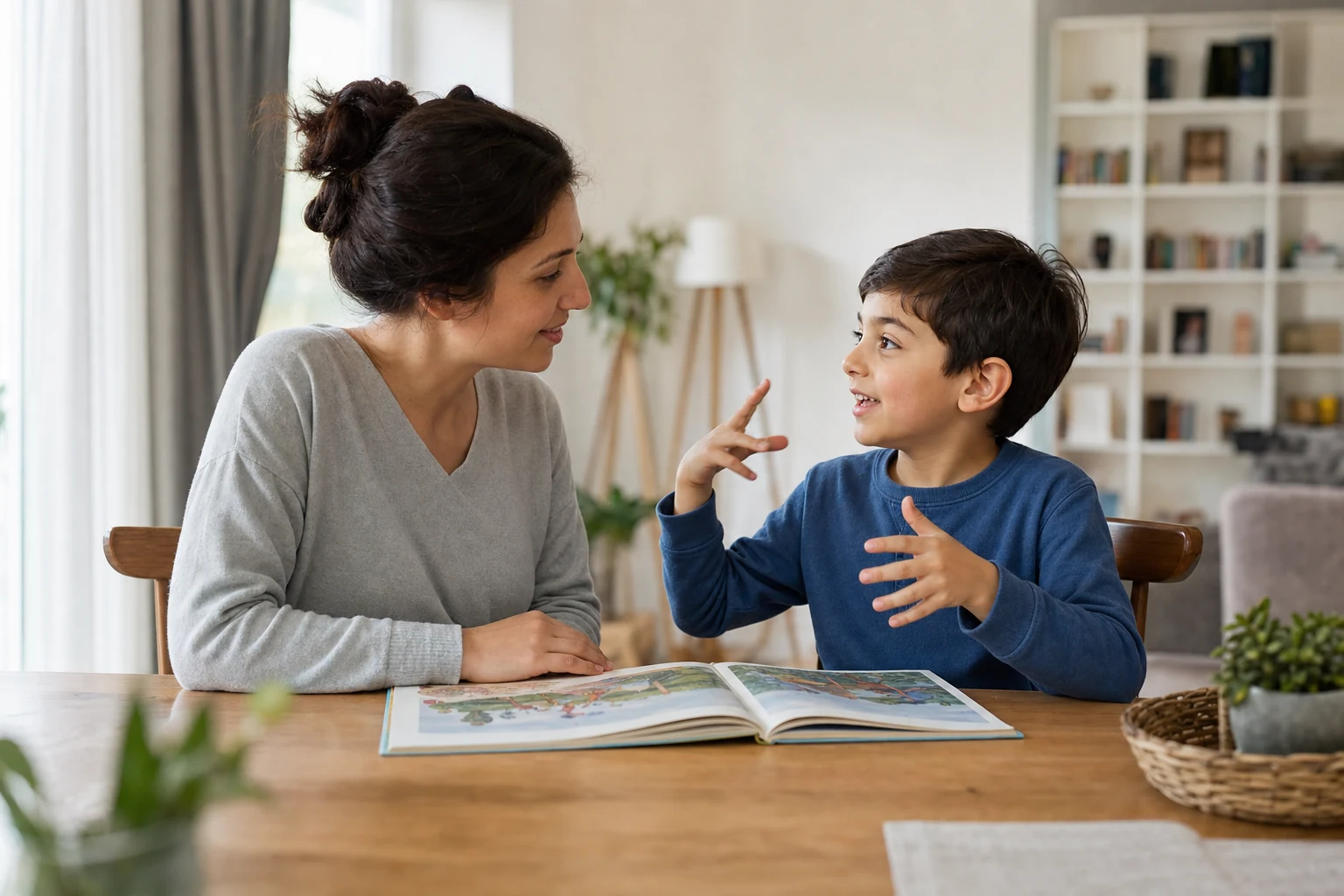
Every child grows at their own pace
6–9 Years: Language Development Guide for Caregivers
Practical ways to support your child’s growing ability to explain ideas, follow classroom routines, tell stories, and build friendships through everyday conversations and shared reading.
General Information: General information only; it may vary from child to child. Talk to your doctor or a specialist before making decisions.
In short
- Children aged 6–9 use language to explain ideas, follow routines, and tell connected stories.
- Home-language support strengthens additional-language learning without pressure or comparison.
- Low-cost strategies like shared reading, open questions, and turn-taking build communication skills daily.
- Persistent difficulty being understood, frustration, or school struggles may need professional attention.
Lumiya Editorial TeamBased on 4 sourcesOur editorial standards
Everyday conversations matter more than you think
Between ages 6 and 9, children’s language shifts from simple sentences to connected stories, explanations, and negotiation. They start to use language not just to name things but to reason, persuade, and share experiences.
Your role isn’t to teach grammar lessons but to create space for real talk. Ask open questions like, "What was the funniest part of your day?" or "How did you solve that problem?" instead of quizzing them. When they describe a soccer game or a book they read, listen for the details they include—and the ones they leave out. That’s how you’ll notice what they’re ready to practice next.

Children learn language best when they feel safe to try, fail, and try again without being corrected every time.
Shared reading builds bridges between speaking, listening, and writing
Reading aloud together isn’t just about bedtime routines—it’s a workout for the brain. When you read a picture book or a chapter from a chapter book, pause to talk about the pictures, predict what might happen next, or connect the story to your child’s life. For example, after reading The True Story of the Three Little Pigs, you might ask, "Do you think the wolf was really trying to bake a cake? Why or why not?"
These discussions help children practice explaining their ideas, using new words, and following longer instructions. They also show how reading and writing connect to speaking and listening. A child who struggles to write a thank-you note might find it easier after retelling a fun weekend event out loud first. The key is to keep it playful: no worksheets, no drills—just conversation sparked by stories.
Try this: Make reading a two-way street
- Pause and predict: After reading a page, ask, "What do you think will happen next?" Let them guess before turning the page.
- Connect to life: "Remember when we baked cookies last weekend? How is that like the story we just read?"
- Act it out: Use stuffed animals or toys to retell the story together. This builds sequencing skills and confidence.
Classroom routines and friendships rely on clear communication
School life demands new kinds of language use. Children must follow multi-step directions, ask for help when they’re stuck, and read social cues like when to raise their hand or when a friend seems upset. A child who struggles might blurt out answers out of turn or avoid group work altogether. These aren’t signs of laziness—they’re signals that they need more practice with turn-taking and understanding unspoken rules.
At home, you can rehearse these skills gently. Play games with simple rules like "Simon Says" or "Red Light, Green Light" to practice listening and waiting. When conflicts arise with siblings or friends, ask, "What could you say to let your friend know you’re upset?" instead of solving the problem for them. This builds their ability to negotiate and advocate for themselves.
Watch for these common challenges
| Setting | Task | What helped | Participation | Change over time |
|---|---|---|---|---|
| Morning routine | Getting dressed and packing backpack | Visual checklist with pictures | Needed reminders but completed most steps | More independent after two weeks |
| Playdate | Sharing toys and taking turns | Parent modeled phrases like "Can I have a turn next?" | Struggled at first, then joined in | Played cooperatively by the third visit |
| School pickup | Explaining the day’s events | Open-ended questions like "What was the best part?" | Gave short answers at first, now tells longer stories | More detailed stories after a month |
The table above shows how small supports—like visual checklists or modeling phrases—can lead to noticeable progress. Notice that the child didn’t master everything at once. Growth happens in small steps, and setbacks are normal.
Language grows in layers, not in lockstep
Speaking, listening, reading, and writing influence one another, but they don’t all develop at the same time. A child might speak in full sentences but still struggle to write a paragraph, or they might love reading aloud but find it hard to follow a conversation in a noisy room. This unevenness is typical and doesn’t mean they’re behind.
Home language plays a special role. If your family speaks a language other than English at home, that’s an asset, not a hurdle. Research shows that strong skills in one language support learning additional languages. The key is to keep using your home language naturally while also exposing your child to English through books, media, and community interactions.

A child who speaks Spanish at home and English at school isn’t confused—they’re building a bilingual brain that will serve them for life.
Low-cost ways to support language every day
You don’t need expensive tools or hours of extra time to make a difference. Small, consistent efforts add up. Here are practical ideas to try this week:
- Word play: Play rhyming games in the car or while cooking. "What rhymes with cat? Hat! Bat! What else?" This builds phonological awareness, which supports reading.
- Turn-taking: Use a talking stick or a stuffed animal to signal whose turn it is to speak during dinner. This teaches patience and listening.
When to seek extra support
Most children will show steady progress with everyday support, but some may need additional help. Trust your instincts if you notice any of the following:
- Your child’s speech is hard for familiar listeners to understand, even after practice.
- They frequently get frustrated when trying to explain their thoughts or follow instructions.
- They avoid talking in group settings or withdraw from social interactions.
- You have concerns about their hearing, swallowing, or breathing.
If any of these apply, reach out to your child’s teacher or healthcare provider. They can offer guidance, screenings, or referrals to speech-language pathologists or audiologists if needed. Early support makes a big difference, but it’s never too late to ask for help.
Respecting differences and fostering belonging
Every child communicates in their own way, shaped by culture, temperament, and experiences. Some children are quiet observers, while others talk nonstop. Some mix languages fluidly, while others prefer one language at a time. Some children need extra time to process language or use alternative communication like sign or pictures. What matters most is that they feel heard and respected.
Avoid comparing siblings or pressuring your child to perform. Instead, focus on their individual strengths and interests. If your child loves building with blocks but struggles with writing, celebrate their creativity and find ways to incorporate storytelling into their play. If they’re bilingual, encourage both languages without forcing a choice.
Remember, language development isn’t a race. It’s a journey of discovery—yours and your child’s. The goal isn’t perfection but connection: helping your child use language to share their world and understand yours.
General Information: This content offers general information based on expert sources. Every child, family and situation is different, so what is described here may vary from person to person. Talk to your doctor or a qualified specialist before making decisions about your child.
Was this article helpful?
This topic at other agesGrowth & Development
Tools for this Age
- Baby and child sleep scheduleHow much should your child sleep in 24 hours, and when should bedtime be? Calculate it from official guidance and compare it with your own log.
- Screen time by ageSee how much screen time a day your country's official body recommends at your child's age; add daily use to compare it with the advice.
- What temperature is a fever in children?See whether the temperature you measured counts as a fever according to your country's official health source, when to get help at your child's age and the warning signs.
- Child Height Predictor & Genetic Target Height CalculatorHow tall will your child be as an adult? Enter both parents' heights to calculate the pediatric mid-parental target height and expected adult height range using the Tanner and AAP formulas.
Checklist
Popular Topics
Frequently Asked Questions
- 1
- 2
- 3
- 4
Editorial Note
Loss of previously used communication skills, persistent difficulty being understood across familiar settings, significant frustration or withdrawal, concern about hearing, swallowing or breathing, bullying, major school participation difficulty or caregiver concern warrants timely local school, hearing, speech-language or health assessment; immediate breathing or safety danger requires emergency help.