
 lumiya.com.tr

A family that grows together
Parenting styles: authoritative, authoritarian, permissive, uninvolved (ages 1-18)
Too strict, or too soft? We separate the four parenting styles with two questions, show four answers to the same bedtime standoff, and explain how two parents with different styles can agree on shared rules.
General Information: General information only; it may vary from child to child. Talk to your doctor or a specialist before making decisions.
In short
- Two things separate the four parenting styles: how much warmth you show and how clear your limits are.
- Authoritative parents do both; authoritarian parents keep the rules but cut back on warmth.
- A style is not a label; every parent slips between styles over the course of a day, and change is possible.
- When two parents disagree, shared rules work best when you settle them privately, not in front of your child.
Lumiya Editorial TeamBased on 5 sourcesOur editorial standards
“Am I too strict, or too soft?” The four main parenting styles come down to two questions: how warm are you with your child, and how clear are your limits?
Authoritative parenting does both, and most research links it with the best outcomes for kids. It isn't a label, though: every parent slips between styles over the course of a day, and you can change.
Authoritative or authoritarian: which two questions sort the four styles?
The first question is warmth: do you listen, make room for your child's feelings, show affection and interest? The second is limits: are the rules clear, do you say what you expect, and do you follow through? Put the two answers together and you get four styles.
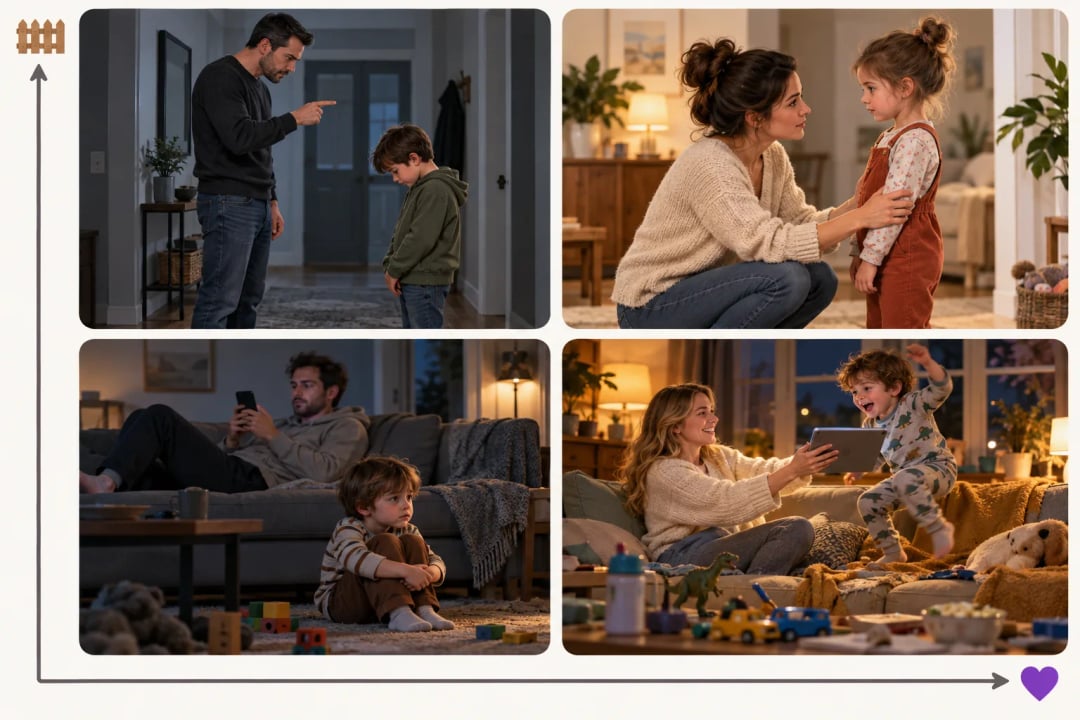
| Style | Warmth | Limits | What you might hear | Often seen alongside it |
|---|---|---|---|---|
| Authoritative | High | Clear, explained | “That's the rule, and here's why.” | Self-belief, school success |
| Authoritarian | Low | Strict, unexplained | “Because I said so.” | A less secure bond with the parent |
| Permissive | High | Few | “Okay, whatever you want.” | Trouble following rules later |
| Uninvolved | Low | Few | “Don't bother me.” | Learning not to expect help |
The pair people mix up most is authoritative and authoritarian, because both have rules. The difference is how the rule is set. Cleveland Clinic describes authoritative parents as encouraging rules “while also giving kids plenty of affection and encouragement,” and authoritarian parenting as a style that enforces rules and boundaries without much space for affection.
Don't read the table as a diagnosis. Anyone can say “Don't bother me” at the end of a long day, and saying it once doesn't make you uninvolved. What counts is where you stand most days.
Four ways to answer “I'm not going to bed!”
It's 8:30 p.m. and your 5-year-old announces, “I'm not tired and I'm not going to bed!” Each style answers the same sentence differently, and your child learns something different from each one.
| Don't | Instead |
|---|---|
| Authoritarian: “Bed. Now. No discussion.” | “I know you're not sleepy. It's still bedtime. Do you want to pick the book, or should I?” |
| Permissive: “Fine, play a little longer” (and it happens again tomorrow) | Repeat the rule kindly, in the same words: “You can play again tomorrow. Now it's bedtime.” |
| Uninvolved: “Do whatever,” without looking up from the screen | Walk over, get down to eye level and start the bedtime routine together |
The authoritative answer has three parts: name the feeling, hold the rule with a short reason, and offer a small choice. The choice sits inside the rule, not instead of it; bedtime doesn't move, but who picks the book can.
Wondering what to do when a rule gets broken anyway? We cover time-outs, consequences and rewards separately.
What does the research actually show about parenting styles?

Hundreds of studies from many parts of the world point the same way: warm, consistent parenting tends to go along with fewer behavior problems and better adjustment, while harsh, rigid or uninvolved parenting goes along with more problems. Most of these studies measure links, not causes. The link can also run both ways: a child with a challenging temperament can push parents toward harshness. And the size of the effect varies from culture to culture.
Studies suggest that kids of authoritative parents experience high levels of self-efficacy (belief in themselves) and academic achievement.
Notice the wording: “studies suggest,” not “will.” A cross-cultural review by Pinquart and Kauser found authoritative parenting linked with at least one positive outcome in every region of the world, and authoritarian parenting with at least one negative outcome, though the strength of those links varied by region. The direction is consistent; no child is explained by parenting style alone.
When parenting styles clash, how do you build shared rules?
It's very common for one parent to be stricter and the other softer, and grandparents add their own style to the mix. What confuses children isn't the different personalities but a rule that changes depending on who they ask. The American Academy of Pediatrics puts it plainly: “Have clear and consistent rules your children can follow.”

- Talk about the disagreement later, not in front of your child. In the moment, don't overrule the other parent; “Let's talk about this tonight” is enough.
- Pick three to five shared rules and write them down. Bedtime, screens and homework, the things that come up every day, are plenty; you don't need to agree on every detail.
- End the “go ask your dad” loop. When your child asks one parent for what the other already refused, answer: “We've already talked about this.”
- Drop the good cop, bad cop roles. If one parent always sets the limits, that parent looks cold and the other looks lax; share both the warmth and the limits.
- If you think you've been too permissive, start with one rule. Say your 8-year-old pushes for more tablet time every night: choose only that rule and hold it the same way every day for two weeks, expecting more pushback at first. If nothing has shifted by then, break it into an easier first step or talk it through with your child again.
How do limits and a child's say change with age?
Warmth stays the same at every age; what changes is how you set limits and how much say your child gets. With a toddler you mostly set the limit; with a teen you negotiate the rule together.
| Age | How limits are set | What your child decides | What you might say |
|---|---|---|---|
| 1–3 | Mostly by arranging the space; short, repeated reminders | One of two choices | “Blue pajamas or green?” |
| 3–6 | With a one-sentence reason | One part of the routine | “Time to brush. You pick the song.” |
| 6–12 | By writing the rules together | Details of the rule | “Games after homework. Let's agree on the time.” |
| 12–18 | With reasons and negotiation | Their own proposal | “What time do you think is fair for Saturday, and why?” |
The AAP's advice for teens is to balance unconditional love and support “with clear expectations, rules, and boundaries,” and Nemours notes that teens still want and need limits even as they get more freedom.
Pushback from a teenager doesn't mean your approach has failed; it's part of a growing say. You'll find more on these years in our guide for ages 12 to 18.
When the yelling won't stop: when is it time to get professional help?
Every parent raises their voice or slips into inconsistency sometimes, and that alone doesn't signal a lasting problem. The time to consider help is when the same cycle won't break: harsh words and yelling have become a daily habit at home, or the gap between you and your partner turns into a fight almost every day.
Has your child's behavior or mood worried you for a long time? Talk with your pediatrician or your child's school counselor. They can help you sort out what's typical for the age and point you to a family therapist if needed.
The American Academy of Pediatrics warns that harsh verbal discipline, even from parents who are otherwise warm and loving, can lead to more misbehavior and mental health problems in children, and recommends positive discipline instead. If your child is in danger right now, call 911.
Our parenting and family section has more on everyday communication at home.
General Information: This content offers general information based on expert sources. Every child, family and situation is different, so what is described here may vary from person to person. Talk to your doctor or a qualified specialist before making decisions about your child.
Was this article helpful?
This topic at other agesParenting styles
Tools for this Age
- Baby percentile calculatorWhere does your child's weight and height sit among children the same age? See it in seconds on the WHO growth curves.
- Baby and child sleep scheduleHow much should your child sleep in 24 hours, and when should bedtime be? Calculate it from official guidance and compare it with your own log.
- Potty training chartWhen to start and how to prepare? A roadmap by age, a daily routine and a printable reward chart.
- Baby milestones by monthCheck off what most children your child's age can do, and talk about the rest with your doctor.
- Baby vaccine schedulePick your country, enter the birth date, and see the official schedule as your own dates.
- Baby teething chart: order and timelineEnter the date of birth to see the typical eruption window of all 20 baby teeth, the next tooth and the teeth already through — on one screen.
Checklist
Popular Topics
Frequently Asked Questions
- 1
- 2
- 3
- 4
References & Further Reading
- 1
- 2
- 3
- 4
- 5
Editorial Note
This article is general information, and every child and family is different. If tension at home is wearing you down, talk with your pediatrician, your child's school counselor or a family therapist.