
 lumiya.com.tr

Understanding feelings builds trust
Toddler punishment, time-out or rewards? What works from ages 1 to 12
Tired of threats that don’t work? How punishment, time-out and rewards differ, which one fits each age from 1 to 12, and how to do a time-out step by step.
General Information: General information only; it may vary from child to child. Talk to your doctor or a specialist before making decisions.
In short
- Rewards and praise make the behavior you want happen more often; punishment on its own doesn’t teach a child what to do instead.
- Time-out is for stopping dangerous or harmful behavior, lasting about 1 minute per year of age in a calm, safe spot.
- If you use a consequence, keep it immediate, brief and linked to the behavior; spanking and shaming cause harm.
- A reward chart works best with one clear goal and small rewards that aren’t candy or money.
Lumiya Editorial TeamBased on 3 sourcesOur editorial standards
You said “If you do that again, no tablet!” and the same fight happened the next day? Toddler punishment is what most parents reach for first, but on its own it works the least.
From ages 1 to 12, the best results come from noticing and rewarding good behavior, a short time-out when needed and small consequences tied to the behavior.
Punishment, time-out or rewards: which one does what?
These three tools don’t do the same job. Rewards make the behavior you want more likely; time-out stops harmful behavior and gives everyone time to calm down. A consequence only helps when it is short, calm and linked to what happened.

| Tool | When? | What it teaches | Watch out |
|---|---|---|---|
| Rewards and praise | Every day, right after the behavior you want | What to do | Don’t turn everything into a prize |
| Time-out | Hitting, throwing, or ignoring a warning | How to stop and calm down | Keep it brief, safe and boring |
| Consequence | A known rule is broken | That behavior has a cost | Immediate, short and related |
| Spanking, yelling, threats | Never | That problems are solved by force | Makes behavior worse |
MedlinePlus puts it simply: discipline involves both punishment and rewards, and the key is to set clear expectations, be consistent and be loving.
In practice, that means catching good behavior most of the day. Short, specific praise like “You gave your brother a turn, that was kind” works far better than a general “good job.”
Which tool fits which age?
The same tool doesn’t work the same way at every age. A 2-year-old can’t connect “no park tomorrow” to what happened today. A 10-year-old follows rules better when they helped make them.
Punishment, time-out and rewards by age
-
Redirect and short breaks
Change the setting instead of lecturing; a couple of minutes of time-out is enough for hitting.
-
Praise and sticker charts
A sticker chart for one goal works well; time-out is about 1 minute per year of age.
-
Natural and logical consequences
A thrown toy goes on the shelf for a while; reward charts can shift to daily chores.
-
Rules you make together
Write rules and consequences together; losing a privilege should be short and known ahead of time.
For more age-specific ideas, see our pages for 3-6 years and 9-12 years.
How do you do a time-out step by step?
Time-out isn’t meant to scare a child. It briefly takes away attention and fun so they can calm down, which is why a dark, locked or frightening place is never used. A cushion or small chair works as a calm-down spot.
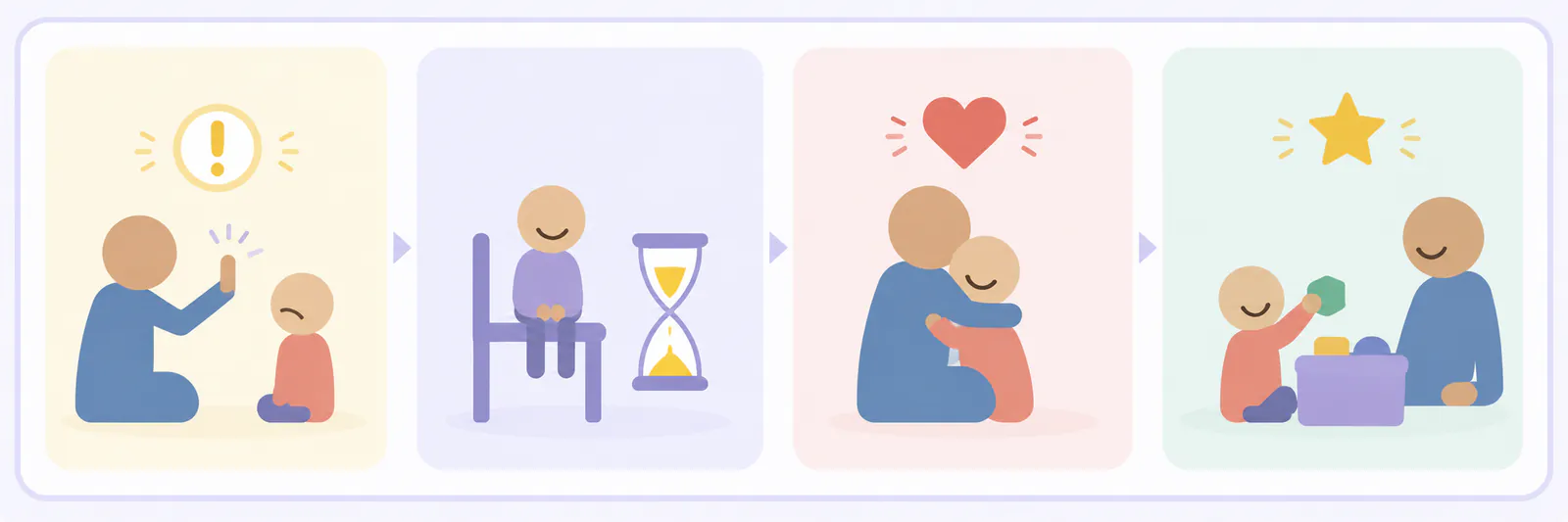
Time-out in 4 steps
-
One calm warning
“If you throw the toy again, you’ll go to time-out.” Say it once, as a statement, in a calm but firm voice.
-
A short time-out
If the behavior continues, your child sits in the calm spot for about 1 minute per year of age. Don’t talk during it.
-
Reconnect
When time is up, go to your child and give a quick hug. Skip the lecture; time-out is over.
-
Try again
Ask again for what you wanted and praise it right away: “You put the toys in the box. Thank you!”
For an 8-year-old, a time-out can be a few minutes of calming down in their own room. The goal is the same: calm down first, talk later.

Sometimes you need the time-out most. When you notice your voice rising, saying “I’m going to calm down for a minute” and taking a deep breath shows your child the best way to handle anger.
How do you set up a reward chart, and when does it backfire?
A reward chart works best with one clear goal. Pick the goal with your child, give a star right after each success, and trade a handful of stars for a small reward.
| Step | Example |
|---|---|
| Goal | Brushing teeth without a fight before bed |
| When is a star given? | Every night, right after brushing |
| How many stars for a reward? | One reward every 5 stars |
| Reward | An extra bedtime story or a game together, not candy or money |
| When does it end? | Once the habit sticks, praise replaces stars |
Hang the chart at your child’s eye level and let them stick the star on themselves. Make the first week’s goal easy, so they get a taste of success.
A chart can backfire, though. If every task is tied to a prize, your child starts asking “What do I get?” before doing anything at all.

Children repeat behavior that is followed by something pleasant, and your attention is the strongest reward there is. Good behavior that goes unnoticed fades, while misbehavior that earns loud attention grows. Rewards and consequences work best when they come right away and the same way every time.
Every time you react to a tantrum, you reward the negative behavior with extra attention.
What kinds of punishment should you avoid?
If you use a consequence, keep it short, immediate and tied to the behavior. Spanking, shaming and scaring don’t work at any age; MedlinePlus notes that hitting shows children it is acceptable to solve problems with violence.
| Don’t | Instead |
|---|---|
| Spank or slap | A short time-out, then a calm talk |
| Say “I don’t love you anymore” | “I love you, and I won’t let you hit.” |
| Use food as a punishment or reward | Reward with attention and time together |
| Ban things for days | A short consequence that ends the same day |
| Invent a punishment in anger | A consequence your child already knows about |
For more on rules and limits, see our listening and limits section.
When to see a doctor
Testing rules now and then, crying in time-out or bargaining for rewards is normal at these ages. Talk to your pediatrician, family doctor or school counselor if you notice the signs on the right.
| See a doctor if | Normal |
|---|---|
| Defying almost every rule for months | Testing rules and pushing back sometimes |
| Often hurting themselves or others | Crying briefly in time-out, then calming |
| Anger at home, school and with friends alike | Bargaining for rewards |
| You often feel you’re losing control too | Listening less when tired |
If you ever feel you might hurt your child or yourself, call or text 988 for immediate support.
The CDC advises using time-out for dangerous, harmful or rule-breaking behavior, keeping it brief, safe and free of distractions, and following up by praising the next good thing your child does.
General Information: This content offers general information based on expert sources. Every child, family and situation is different, so what is described here may vary from person to person. Talk to your doctor or a qualified specialist before making decisions about your child.
Was this article helpful?
This topic at other agesEmotions & Behavior
Tools for this Age
- Baby percentile calculatorWhere does your child's weight and height sit among children the same age? See it in seconds on the WHO growth curves.
- Baby and child sleep scheduleHow much should your child sleep in 24 hours, and when should bedtime be? Calculate it from official guidance and compare it with your own log.
- Potty training chartWhen to start and how to prepare? A roadmap by age, a daily routine and a printable reward chart.
- Baby milestones by monthCheck off what most children your child's age can do, and talk about the rest with your doctor.
- Baby vaccine schedulePick your country, enter the birth date, and see the official schedule as your own dates.
- Baby teething chart: order and timelineEnter the date of birth to see the typical eruption window of all 20 baby teeth, the next tooth and the teeth already through — on one screen.
Checklist
Popular Topics
Frequently Asked Questions
- 1
- 2
- 3
- 4
- 5
Editorial Note
This article gives general information; every child and family is different. If behavior problems last a long time, affect school or family life, or worry you, talk to your pediatrician, family doctor or school counselor.
Other situations in this topic
Dealing with a different side of the same topic? Each situation has its own guide.
- Understanding the need behind the behaviorLearn how to interpret your child’s behavior as communication shaped by development, needs, and context. Discover practical steps to observe, respond, and support without punishment or diagnosis.1 items
- Won't listen, says no to everything, tests limitsTantrums and refusal to listen can feel overwhelming at ages 1–6, but understanding their causes and responding with calm, consistent strategies helps both child and parent. Learn age-appropriate ways to set limits, prevent meltdowns, and build cooperation.1 items
- Defiant, argues back and won't cooperateArguing back, bargaining and pushing rules are common from 6 to 12. Here is how to hold a limit without a power struggle, and how the approach shifts between 6-9 and 9-12.1 items