
 lumiya.com.tr
Understanding feelings builds trust
Defiant child who argues back: calm limits that work from 6 to 12 years
Arguing back, bargaining and pushing rules are common from 6 to 12. Here is how to hold a limit without a power struggle, and how the approach shifts between 6-9 and 9-12.
General Information: General information only; it may vary from child to child. Talk to your doctor or a specialist before making decisions.
In short
- Arguing, bargaining and testing rules are a normal part of development for most children between 6 and 12.
- At 6-9 the trigger is often fairness; at 9-12 it is autonomy and wanting a say, so the approach changes.
- Inconsistent rules and long debates feed defiance; a few clear rules applied the same way every time shrink it.
- Spanking, yelling and harsh words do not work and tend to increase anger and aggression.
Lumiya Editorial TeamBased on 3 sourcesOur editorial standards
Between 6 and 12, arguing back, bargaining and refusing requests are common and usually part of normal development. What helps most is a short list of clear rules, applied the same way every time, and a focus on the limit rather than on winning the argument.
Why school-age kids push back so hard
Once school starts, children meet teachers, class rules and peer groups. "Because I said so" stops working: they want to know the reason and whether the rule is fair. That questioning comes from growing reasoning skills, and it is not a problem on its own.
What does make it worse is inconsistency and harshness. The American Academy of Pediatrics advises parents not to spank or hit children, and notes that harsh physical and verbal punishment can damage a child's long-term health.

The brain systems that put the brakes on strong feelings keep maturing well into the teen years. A 9-year-old can argue a case brilliantly, yet still struggle to stop once frustration takes over. Punishment that frightens the child adds stress without building the self-control that is still under construction.
Instead of teaching responsibility and self-control, spanking often increases aggression and anger in children.
Ages 6-9: "That's not fair!"
Defiance at this age is often about fairness: a sibling stays up later, a friend has a tablet. Hunger, tiredness and a hard day at school make every request harder to accept.
Ages 9-12: "You can't tell me what to do"
Pre-teens want a say. Eye-rolling, slammed doors and "you don't get it" are common. Rules that are worked out together hold up much better than rules handed down.
A 4-step way to hold a limit without a power struggle
In the heat of the moment, the goal is to protect both the rule and the relationship.
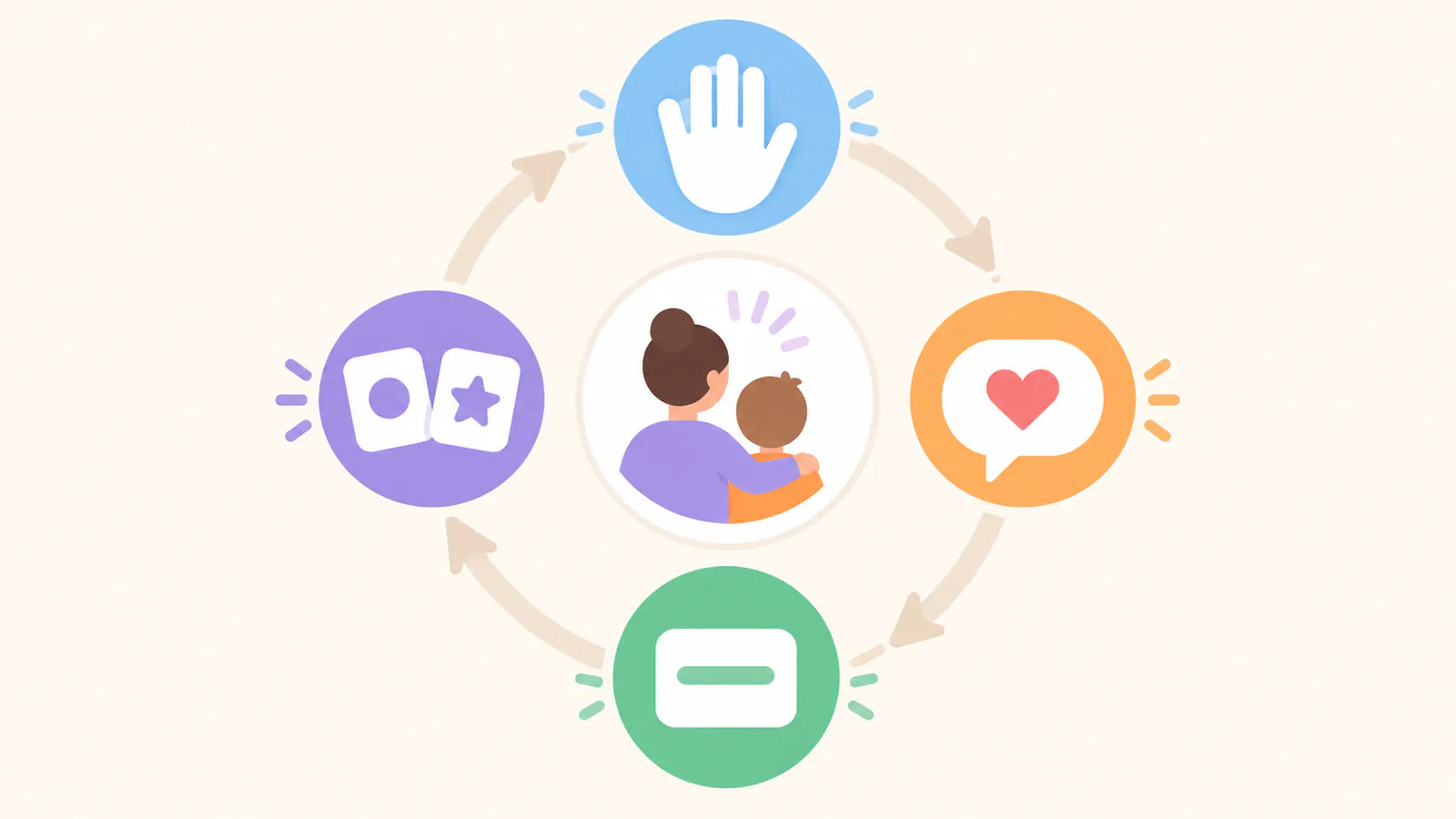
When the argument starts
-
Pause and breathe
Take a few seconds before you answer. Your calm is what lets your child calm down.
-
Name the feeling
"You're really mad that the game has to stop." Feeling understood does not mean the rule changes.
-
State the rule once
"Screen time is over." Skip the lecture and the bargaining; repeat the same sentence calmly if needed.
-
Offer two choices
"Turn it off now or in five minutes?" Choices also meet a pre-teen's need for control.
It may not work the first time. What matters is that your child learns the answer will be the same every time.
Rules that work at home, and myths that backfire
Keep the list short and focus on what matters most. With 9- to 12-year-olds, review house rules together in a brief weekly family check-in. Notice and name it when your child cooperates; behavior that gets attention is repeated.
How common physical punishment still is
-
1.2 billion
Children physically punished at home each year
-
17%
Children who faced severe physical punishment in the past month
| Myth | Fact |
|---|---|
| A stubborn child needs a firm spanking. | Physical punishment is linked to more aggression, not better behavior. |
| Every "why?" deserves a full explanation. | Long debates reward arguing; one calm, repeated sentence works better. |
| Parents who set limits are less loving. | Clear limits make children feel safe; warmth is shown in other ways. |
| Defiance at this age means bad character. | It is often about tiredness, hunger, school stress or a sense of fairness. |

After a long day, your child's "no" can feel like a personal attack. It isn't. If you catch yourself losing your temper, saying "I'm too angry to talk right now, let's try again in five minutes" is one of the best lessons in handling anger you can give.
Sleep matters more than most parents expect: tired kids blow up faster. See the 6-9 years and 9-12 years pages for age-based routines, and the listening and limits section for related situations.
When to see a doctor
Talk to your child's pediatrician or the school counselor if:
- Angry, defiant behavior has lasted more than 6 months and is clearly stronger than in other children the same age. MedlinePlus notes that oppositional defiant disorder typically starts by age 8.
- The behavior is causing real problems at school or with friends.
- Your child hurts themselves, siblings or animals, or deliberately destroys things.
- Defiance comes with ongoing sadness, withdrawal, or changes in sleep or appetite.
- You find it hard to control your own anger or notice you are using physical punishment.
The World Health Organization reports that corporal punishment harms children's physical and mental health, increases behavioural problems over time and has no positive outcomes. If anyone is in immediate danger, call 911.
General Information: This content offers general information based on expert sources. Every child, family and situation is different, so what is described here may vary from person to person. Talk to your doctor or a qualified specialist before making decisions about your child.
Was this article helpful?
This topic at other agesEmotions & Behavior
Tools for this Age
- Baby and child sleep scheduleHow much should your child sleep in 24 hours, and when should bedtime be? Calculate it from official guidance and compare it with your own log.
- Screen time by ageSee how much screen time a day your country's official body recommends at your child's age; add daily use to compare it with the advice.
- What temperature is a fever in children?See whether the temperature you measured counts as a fever according to your country's official health source, when to get help at your child's age and the warning signs.
- Child Height Predictor & Genetic Target Height CalculatorHow tall will your child be as an adult? Enter both parents' heights to calculate the pediatric mid-parental target height and expected adult height range using the Tanner and AAP formulas.
Checklist
Popular Topics
Frequently Asked Questions
- 1
- 2
- 3
- 4
- 5
Editorial Note
This article offers general information; every child and family is different. For advice about your own child, talk with your pediatrician, the school counselor or a licensed child mental health professional.
Other situations in this topic
Dealing with a different side of the same topic? Each situation has its own guide.
- Understanding the need behind the behaviorLearn how to interpret your child’s behavior as communication shaped by development, needs, and context. Discover practical steps to observe, respond, and support without punishment or diagnosis.1 items
- Punishment, time-out or rewards: what works?Tired of threats that don’t work? How punishment, time-out and rewards differ, which one fits each age from 1 to 12, and how to do a time-out step by step.1 items