
 lumiya.com.tr

Balanced plates, happy tables
When can babies have water, cow's milk, honey and juice? (0-3 years)
When can babies have water, cow's milk, honey or juice, and how much is enough? A month-by-month drink timeline and daily amounts from the CDC and the American Academy of Pediatrics.
General Information: General information only; it may vary from child to child. Talk to your doctor or a specialist before making decisions.
In short
- For the first 6 months, breast milk or formula covers all of a baby's fluid needs.
- Around 6 months you can offer 4-8 ounces (about 120-240 ml) of water a day in an open or straw cup.
- Whole cow's milk can be introduced as a drink at 12 months, but not before; about 2 cups a day is enough at 12-24 months.
- Honey and juice both wait until after the first birthday; whole fruit is always a better choice than juice.
Lumiya Editorial TeamBased on 5 sourcesOur editorial standards
Your 7-month-old grabs your glass at dinner and the question pops up: when can babies have water, and what about cow's milk? The short answer: small sips of water from about 6 months and cow's milk as a drink at 12 months. Honey and juice both wait until after the first birthday.
Which drink starts at which age?
For the first 6 months, breast milk or formula gives your baby all the fluid they need. After that, drinks are added one at a time and in a clear order. Guidance from the CDC and the American Academy of Pediatrics (AAP) lines up like this.
Drink timeline, 0-3 years
-
Breast milk or formula only
No water or other drinks needed; milk covers your baby's fluids.
-
Water: first sips
4-8 oz (about 120-240 ml) a day with meals, from an open or straw cup.
-
Whole cow's milk
Cow's milk can become a drink; about 2 cups (16 oz) a day at 12-24 months.
-
Honey is safe
The honey rule ends at the first birthday.
-
Juice only if needed
No more than 4 oz of 100% juice a day; whole fruit is preferred.
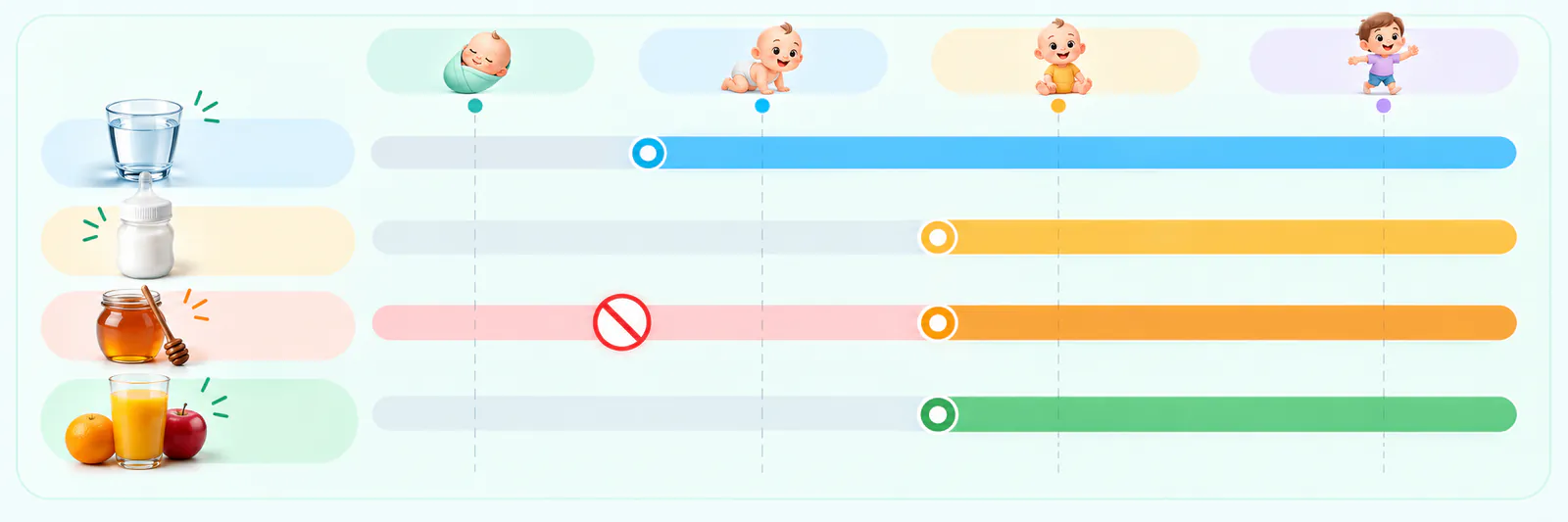
This timeline sums up our guide to drinks for babies and toddlers. Below we go through each drink with daily amounts.
When can babies have water, and how much?
A baby who is breastfed or formula-fed doesn't need extra water for the first 6 months. Water arrives with solid foods. At first the point is learning to use a cup, not quenching thirst.
The AAP suggests the following daily amounts. One cup is 8 ounces, about 240 ml.
| Age | Water per day | How to offer it |
|---|---|---|
| 0-6 months | None needed | Breast milk or formula is enough |
| 6-12 months | 4-8 oz (0.5-1 cup) | Plain water with meals, open or straw cup |
| 12-24 months | 8-32 oz (1-4 cups) | With meals and in between, when thirsty |
| 2-3 years | 8-40 oz (1-5 cups) | Water becomes the main drink |
An open or straw cup builds drinking skills better than a bottle. Try saying “Look, I'm drinking too!” to your 9-month-old, take a sip from your own cup, then hand them theirs.

If your baby spits the water out or pushes the cup away, that's fine. At this stage what matters is getting to know the cup, not how much goes down; just offer it again at the next meal.
Cow's milk before and after 12 months
The CDC advises introducing whole cow's milk at 12 months, but not before. Before then it may put babies at risk for intestinal bleeding, and it has too many proteins and minerals for a baby's kidneys to handle easily.
After the first birthday, milk moves into the cup. The AAP suggests about 2 cups (16 oz) of whole milk a day at 12-24 months, then 2-3 cups of nonfat or low-fat milk from age 2.
| Myth | Fact |
|---|---|
| “The more milk, the stronger the bones.” | About 2 cups a day is enough at 1-2 years; too much milk leaves less room for other nutritious foods. |
| “Oat or almond drink can replace cow's milk.” | Plant drinks are not a nutritional match for cow's milk for most toddlers; ask your pediatrician before switching. |
| “Toddler formula is a must after 1.” | From 12 months the AAP recommends plain milk and water; it calls toddler milks unnecessary. |
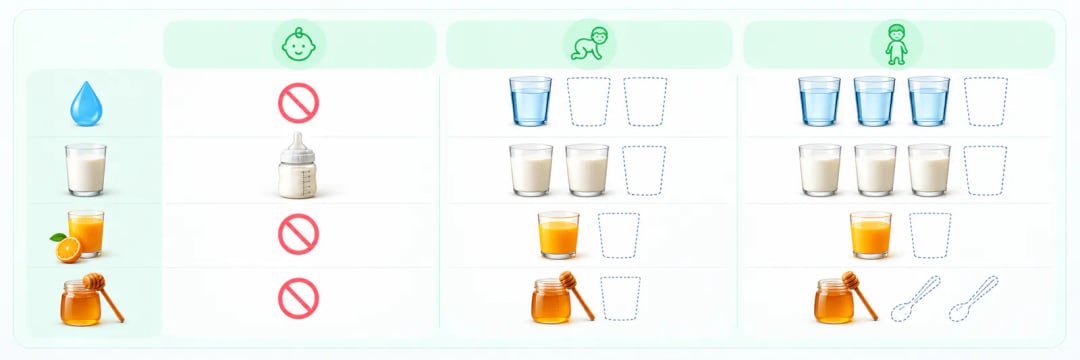
Why do honey and juice have to wait?
The reasons are different. Honey is a safety issue; juice is a nutrition issue.

Honey can carry spores of Clostridium botulinum, a bacterium found in soil and dust. In babies under one, gut bacteria are not yet mature, so the spores can grow in the intestine and make a toxin that affects the nerves; this is infant botulism. In older children and adults, established gut bacteria prevent this.
Honey given to children younger than 12 months may cause a severe food poisoning called botulism.
So during the first year:
- Don't give honey raw or baked into homemade foods.
- Don't dip a pacifier in honey or add honey to water, formula or food.
- Tell relatives “We'll taste honey together on her first birthday” so everyone follows the same rule.
Juice is different: the problem is sugar and missing fiber, not safety. The AAP says infants under 1 year should not drink juice, and 2-3 year-olds should have no more than 4 ounces a day.
| Watch out | Normal |
|---|---|
| A juice bottle or sippy cup carried around all day | A small glass of 100% juice with breakfast for a 2-year-old |
| Giving juice before the first birthday | Serving fruit sliced or mashed |
| Using juice drinks or sugary drinks instead of water | Offering water first when your child is thirsty |
Why do countries give different advice?
Official bodies agree on the basics: no honey and no cow's milk as a drink before 1 year. The details, like when water starts, differ. That doesn't mean anyone is wrong; feeding habits simply vary from country to country.
| Country (agency) | When does water start? | Key difference |
|---|---|---|
| US (CDC, AAP) | Around 6 months | Whole milk at 1-2 years, nonfat or low-fat from age 2 |
| UK (NHS) | Sips with meals from around 6 months | Tap water for babies over 6 months doesn't need boiling |
| Germany (BIÖG) | Once the third solid meal is in place, usually 7-9 months | About 600-700 ml of drinks a day once on family foods |
Don't let the differences worry you. For your baby in the 0-12 months and 1-3 years stages, your pediatrician can tell you the right amounts based on growth.
When to see a doctor
It's normal for a baby to refuse water or drink more milk one day and less the next. Call your pediatrician or family doctor promptly if you notice:
- Constipation, weak sucking, a weak cry or poor head control in the days after honey before age 1
- Far fewer wet diapers, dark urine or a dry mouth
- A toddler who drinks milk but eats hardly anything else, or seems pale and tires easily
- Vomiting, hives or blood in the stool after milk or dairy
This article is general information; talk to your pediatrician about what's right for your child.
The CDC advises no honey before 12 months and no cow's milk as a drink before 12 months. If your baby has trouble breathing or swallowing or seems unusually floppy, call 911.
General Information: This content offers general information based on expert sources. Every child, family and situation is different, so what is described here may vary from person to person. Talk to your doctor or a qualified specialist before making decisions about your child.
Was this article helpful?
This topic at other agesFeeding & Nutrition
Tools for this Age
- Baby percentile calculatorWhere does your child's weight and height sit among children the same age? See it in seconds on the WHO growth curves.
- Baby and child sleep scheduleHow much should your child sleep in 24 hours, and when should bedtime be? Calculate it from official guidance and compare it with your own log.
- Baby milestones by monthCheck off what most children your child's age can do, and talk about the rest with your doctor.
- Baby vaccine schedulePick your country, enter the birth date, and see the official schedule as your own dates.
- Baby teething chart: order and timelineEnter the date of birth to see the typical eruption window of all 20 baby teeth, the next tooth and the teeth already through — on one screen.
- Baby feeding schedule: weaning chart by monthEnter your country and the date of birth: when to start solids, meals and textures by age, and until when to avoid certain foods — with dates.
Checklist
Popular Topics
Frequently Asked Questions
- 1
- 2
- 3
- 4
- 5
References & Further Reading
- 1
- 2
- 3
- 4
- 5
Editorial Note
This article is general information; every baby grows and eats differently. Ask your pediatrician or family doctor what amounts are right for your child.