
 lumiya.com.tr

Balanced plates, happy tables
My child only eats in front of a screen and won’t sit at the table (ages 1 to 6)
No bite without the tablet, up and off the chair the moment the show ends? Why the screen habit forms, how long toddlers can really sit, a step-by-step plan for screen-free meals and when to call your pediatrician.
General Information: General information only; it may vary from child to child. Talk to your doctor or a specialist before making decisions.
In short
- Eating in front of a screen is a very common habit between ages 1 and 6, and it can change within a few weeks.
- Screens pull attention away from food, so children miss how much they eat and when they are full.
- A warning before meals, a basket for devices and sitting face to face are the steps that help most.
- The CDC says toddler meals can last 10 to 15 minutes, or as long as your child can pay attention.
Lumiya Editorial TeamBased on 4 sourcesOur editorial standards
Does your child refuse to open their mouth until the tablet or TV is on, then slide off the chair the moment it goes dark? Between ages 1 and 6 this is a very common habit, and it can change within a few weeks.
What helps most is taking screens off the table completely, keeping meals short and eating together without pressure.
Why will my child only eat in front of a screen?
The habit usually starts with good intentions: one cranky evening a show goes on, the food goes down, and it quietly becomes the routine. Soon your child links eating with the screen. Without it, the table feels boring.
MedlinePlus, from the U.S. National Library of Medicine, advises parents not to let children eat while watching TV or using a computer.
Some children eat far more than they need with a show on. Others barely eat once it is switched off, because the meal has become about the screen, not the food.
Chewing suffers too when attention is elsewhere, and toddlers are still learning to handle new textures. A calm table gives them the chance to notice what is in their mouth.

Fullness signals travel slowly from the stomach to the brain, and a child needs to be paying attention to notice them. Bright colors and sound on a screen capture that attention, so the child misses taste, texture and the feeling of being full and opens their mouth almost automatically. At screen-free meals, children practice reading their own hunger and fullness.
Children eat more when they are watching TV, especially if they see ads for food.
How long can a toddler really sit at the table?
Expecting a toddler to sit through a long dinner sets everyone up for a fight. Attention spans are short and grow with age, and for an 18-month-old baby even 10 minutes at the table is a good meal.
A 2-year-old who wants down after a few bites is behaving normally. Calmly ending the meal works far better than bringing back the screen to buy a few more spoonfuls.
What to expect at the table by age
-
Start screen-free
The AAP recommends no screens before 18 months, apart from video chats with family, so meals start without them.
-
10-15 minutes
The CDC says meals can last 10 to 15 minutes, or for as long as your child can pay attention.
-
Short and cheerful
Your child may want down after a few bites; when they leave, the meal is over and no screen makes up for it.
-
Around 20 minutes
Your child can help set the table and join the conversation, and meals gradually get longer.
Health agencies in different countries suggest slightly different meal lengths, but they agree on the essentials: keep meals short and switch screens off.
| Country and agency | Meal length | Screen advice |
|---|---|---|
| United States — CDC | 10-15 minutes, or as long as your child can pay attention | Don’t let TV, videos or cell phones distract your child from eating |
| Netherlands — Voedingscentrum | No more than 20-30 minutes; give a 5-minute warning | Eat with attention, without TV or phone |
| Spain — AEPap (Familia y Salud) | 30-40 minutes is more than enough | Avoid TV, other screens, toys and songs at meals |
How do I get screens off the table?
Going cold turkey and phasing screens out gradually can both work, as long as every adult follows the same plan. Tell your child ahead of time, in one short sentence: “From today, no tablet at dinner. We’re going to talk instead.”
MedlinePlus is clear: do not allow TV watching during meals, and do not leave the TV on for background noise. When your own phone goes in the basket too, the rule feels like a family routine rather than a punishment.
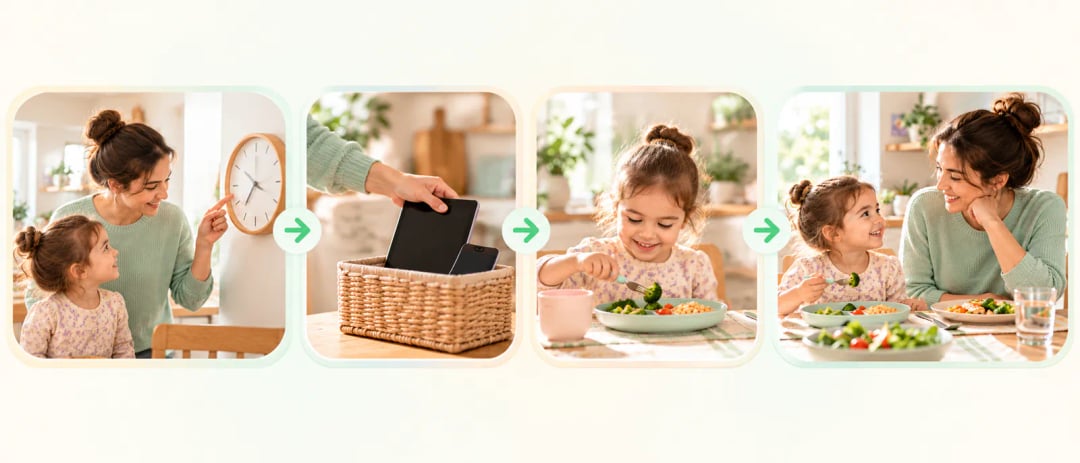
Switching to screen-free meals: 5 steps
-
Give a heads-up
Avoid pulling your child away mid-play: “Five more minutes with the blocks, then it’s dinner time.”
-
Give devices a home
Tablets and phones go into a basket away from the kitchen before the meal, and the TV stays off, even in the background.
-
Make your child a helper
Small jobs like putting out napkins or carrying the bread basket connect your child to the table.
-
Sit face to face
The CDC suggests facing your child toward you or other family members at the table, and eating the same food yourself.
-
Keep it short
When the meal time is up, calmly clear the plate and offer nothing until the next planned snack.
What to do in the first screen-free days
In the first days your child may cry, eat very little or leave the table, and that is an expected reaction. A healthy child who eats little at one meal usually makes up for it at the next one.
Fill the gap the screen leaves with talk. Chat about color, crunch and smell: “Is your carrot crunchy or soft?” Ask about their day, but don’t turn the table into a place for lectures or discipline.
Meals are a natural time for family conversation, and a calm table makes that possible. Your child gets to decide how much to eat, and you decide what, when and where food is served.
| Don’t | Instead |
|---|---|
| Bargain: “One more bite and I’ll put the show on” | Keep screens and food completely separate |
| Follow your child around the house with a plate | Serve food only at the table |
| Push them to clean the plate | Let your child decide how much to eat |
| Scold them for getting up | Calmly say, “If you’re getting down, dinner is finished” |
| Scroll your own phone at the table | Put your phone in the basket too |

Wanting a quiet dinner after a long day, with a show doing the work, is completely human. This habit doesn’t make you a bad parent. Starting with just one screen-free meal a day is a real win.
A sample screen-free dinner
Here is one possible evening for ages 2 to 6; shift the times to fit your family.
- 5:45 p.m. — “Dinner in five minutes!” and all devices go into the basket.
- 5:50 p.m. — Wash hands; your child hands out napkins and spoons.
- 5:55 p.m. — Everyone sits at the same table and starts with a small serving of the same food.
- 6:15 p.m. — Time is up; everyone leaves the table, eaten or not, and plates are cleared.
- 6:20 p.m. — A book or a game together; if there is screen time, keep it short and chosen in advance.
For more on this topic, see our section on self-feeding and mealtime habits, and find age-specific tips on the 1-3 years and 3-6 years pages.
When to see a doctor
For most children, eating in front of a screen is a habit, not a medical problem. The table below helps you tell what is typical from what needs a closer look.
| Typical | Check with your pediatrician |
|---|---|
| Eating little at screen-free meals in the first days | Still refusing to eat without a screen after several weeks |
| Sitting for 10-20 minutes, then getting up | Not gaining weight, losing weight or dropping on the growth chart |
| Eating a lot some days and very little on others | Accepting only a handful of foods, gagging or vomiting with new foods |
| Crying briefly when the screen goes off | Struggling to chew or swallow, or often choking on food |
If you see these signs, talk to your pediatrician, who may refer you to a feeding specialist or dietitian. If your child is choking and cannot breathe, cough or speak, call 911 right away.
The CDC encourages parents to watch for signs that their child is hungry or full, and to keep TV, videos and cell phones away from meals so the child can focus on eating. Its guidance also notes that mealtimes can last 10 or 15 minutes, or as long as the child can pay attention.
General Information: This content offers general information based on expert sources. Every child, family and situation is different, so what is described here may vary from person to person. Talk to your doctor or a qualified specialist before making decisions about your child.
Was this article helpful?
This topic at other agesFeeding & Nutrition
Tools for this Age
- Baby percentile calculatorWhere does your child's weight and height sit among children the same age? See it in seconds on the WHO growth curves.
- Baby and child sleep scheduleHow much should your child sleep in 24 hours, and when should bedtime be? Calculate it from official guidance and compare it with your own log.
- Potty training chartWhen to start and how to prepare? A roadmap by age, a daily routine and a printable reward chart.
- Baby milestones by monthCheck off what most children your child's age can do, and talk about the rest with your doctor.
- Baby vaccine schedulePick your country, enter the birth date, and see the official schedule as your own dates.
- Baby teething chart: order and timelineEnter the date of birth to see the typical eruption window of all 20 baby teeth, the next tooth and the teeth already through — on one screen.
Checklist
Popular Topics
Frequently Asked Questions
- 1
- 2
- 3
- 4
- 5
Editorial Note
This article offers general information; every child’s appetite and temperament are different. If you are worried about weight gain, growth or swallowing, talk to your pediatrician or family doctor.