 lumiya.com.tr

Understanding feelings builds trust
Separation anxiety: my child cries when I leave (8 months to 6 years)
Clinging at daycare drop-off, crying the moment you leave the room? Why separation anxiety happens, when it usually fades, a quick goodbye ritual that works and when to talk to your pediatrician.
General Information: General information only; it may vary from child to child. Talk to your doctor or a specialist before making decisions.
In short
- Separation anxiety usually becomes clear around 9 months and is a normal sign of a secure attachment.
- It typically fades after age 2, but can return during changes such as starting daycare or preschool.
- A short goodbye that is the same every day, plus a concrete return time, is the step that helps most.
- Sneaking out or coming back when your child cries makes goodbyes longer and harder.
Lumiya Editorial TeamBased on 4 sourcesOur editorial standards
Does your toddler cling to your leg at daycare, shouting “Don’t go!”, or follow you every time you leave the room? From infancy to the preschool years, many children cry when a parent leaves; this separation anxiety is usually a normal part of development and fades with time.
What helps most is a short goodbye that is the same every day, a concrete return time and practice with brief separations at home.
Why can’t my child let me go?
Around 8 to 9 months, a baby starts to understand that you are a separate person who still exists when out of sight. But your baby cannot yet predict when you will come back. That is why a 10-month-old may cry even when you just step into the kitchen.
MedlinePlus, the U.S. National Library of Medicine’s health site, notes that from 8 to 14 months children often become frightened when they meet new people or visit new places. They see their parents as familiar and safe, so being apart feels threatening.
So the crying is a sign of secure attachment, not spoiling or a bad habit. Wariness of unfamiliar faces often appears at the same time.

Separation anxiety begins with “object permanence”: understanding that something keeps existing even when you can’t see it. Your child knows you exist but cannot measure time, so crying is a way to keep you close. Each time you leave and come back, the brain learns the pattern “she goes, but she returns,” and the crying gets shorter.
Separation anxiety is a normal stage as a child grows and develops.
At what age does it start, and when does it end?
According to the American Academy of Pediatrics (AAP), some babies show separation anxiety as early as 4 to 5 months, but most develop more robust separation anxiety at around 9 months. Some toddlers who skip it as babies start having trouble at 15 or 18 months.
MedlinePlus says it usually ends when the child is around 2 years old. But starting daycare or preschool, moving house or a new sibling can bring it back, even for a 4-year-old.
Separation anxiety by age
-
Early starters
Some babies fuss briefly when a parent leaves their sight.
-
Becomes clear
Most babies show it around 9 months; wariness of strangers often joins in.
-
Toddlers
As independence grows, separations become louder and more tearful.
-
Easing
Your child begins to understand you will come back; the anxiety eases for most.
-
New beginnings
Preschool, a move or a new sibling can bring it back for a while.
How can I prepare my child for separations?
Preparation starts long before the goodbye. Beginning with short separations at home and slowly making them longer lets your child collect the experience that you leave and always come back.
Preparing for separations: 5 steps
-
Short separation games at home
Play peekaboo, then step into the next room and keep talking: “I’m in the kitchen, I’ll be right back!”
-
Get to know the new caregiver together
Stay for the first visits, then shorten your stay a little each day.
-
Avoid goodbyes when hungry or tired
The AAP notes that separations are harder when children are hungry, tired or sick. Plan drop-off after a nap or a meal when you can.
-
Give a concrete return time
Use an event your child knows instead of a clock: “I’ll pick you up after your nap.”
-
A comfort object
A small favorite toy or blanket can come along; the smell of home is reassuring.
What should I do at the moment of goodbye?
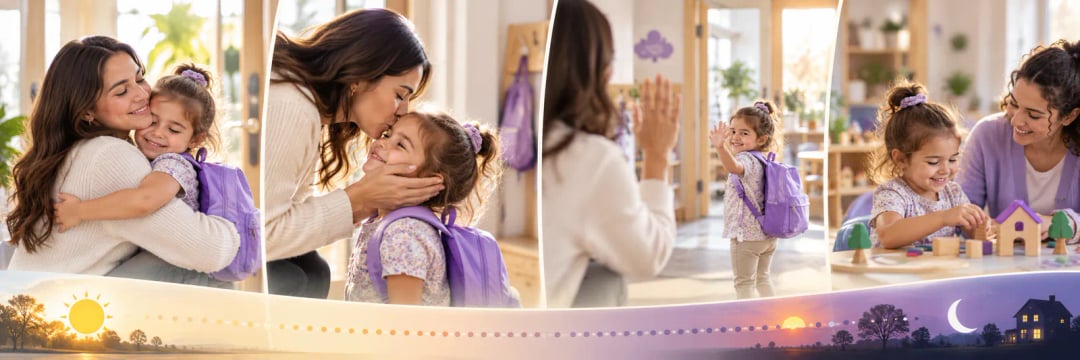
The AAP’s advice is simple: create quick goodbye rituals and do the same drop-off at the same time each day. Be consistent, and don’t return to the room because your child pleads with you.
Keep it short, warm and predictable: one hug, three kisses, one wave. Then really leave. Naming the feeling tells your child you understand: “I can see it’s hard to say goodbye. I’ll pick you up after your nap.”
| Don't | Instead |
|---|---|
| Sneak out while your child isn’t looking | Say a short, clear goodbye: “I’m leaving now, I’ll be back this afternoon.” |
| Come back when your child cries and stretch out the goodbye | Finish the ritual, leave, and check in with the teacher later |
| Threaten: “If you cry, I’ll leave you here” | Name the feeling: “I know you’ll miss me. I’ll miss you too.” |
| Promise vaguely: “I’ll be back in a bit” | Give a concrete time: “I’ll be back after lunch.” |
| Let your own worry show on your face | Use a calm voice and a confident smile |
Official bodies in different countries give very similar advice: keep goodbyes short, be consistent and give it time.
| Country and organization | Key recommendation |
|---|---|
| United States — American Academy of Pediatrics | Quick goodbye rituals; don’t return because of pleas and don’t cancel plans because of separation anxiety |
| Netherlands — Nederlands Jeugdinstituut | Say a short, clear goodbye when bringing your child to daycare, a sitter or a relative |
| Germany — BIÖG (kindergesundheit-info.de) | Separation fears are among a child’s first strong feelings; most children manage them largely on their own by school entry |
What helps after the separation?
The reunion is part of the goodbye too. When you pick your child up, put your phone away and give a few minutes of full attention, so the experience “she came back when she said” sticks.
Ask about the day without turning it into an interrogation. Don’t make a tearful morning a reason for punishment; planning tomorrow’s goodbye together makes your child part of the solution: “Should we do three kisses at the door tomorrow, or five?”

It hurts to walk away while your child cries, and feeling guilty is completely natural. You don’t have to hide your worry, but try not to carry it into the goodbye; a deep breath, a short farewell and telling yourself “She is safe, and I will be back” calm you both.
You can find more articles in our separation anxiety section, and age-specific advice on the 1-3 years and 3-6 years pages.
When to see a doctor
Normal separation anxiety needs no treatment and eases with time. This table helps you tell what is typical from what deserves a closer look.
| Worth checking — ask a professional | Normal |
|---|---|
| Not calming down for hours at every separation, getting worse over weeks | Crying for a few minutes at drop-off, then playing |
| Refusing school every day after age 6 | A hard few weeks when starting daycare |
| Regular stomachaches, headaches or nausea before separations | Waking at night and calling for you |
| Frequent fears that something bad will happen to you or to them; disrupted sleep or appetite | A temporary return after illness, a move or a new sibling |
If these signs last for several weeks and make daily life hard, talk to your pediatrician or family doctor. They can refer you to a child mental health professional, and a school counselor can help once your child starts school.
MedlinePlus, from the U.S. National Library of Medicine, advises that if severe separation anxiety continues past age 2, a visit to your child’s health care provider can help check for an anxiety disorder or another condition. In an emergency, call 911.
General Information: This content offers general information based on expert sources. Every child, family and situation is different, so what is described here may vary from person to person. Talk to your doctor or a qualified specialist before making decisions about your child.
Was this article helpful?
This topic at other agesSeparation anxiety
Tools for this Age
- Baby percentile calculatorWhere does your child's weight and height sit among children the same age? See it in seconds on the WHO growth curves.
- Baby and child sleep scheduleHow much should your child sleep in 24 hours, and when should bedtime be? Calculate it from official guidance and compare it with your own log.
- Baby milestones by monthCheck off what most children your child's age can do, and talk about the rest with your doctor.
- Baby vaccine schedulePick your country, enter the birth date, and see the official schedule as your own dates.
- Baby teething chart: order and timelineEnter the date of birth to see the typical eruption window of all 20 baby teeth, the next tooth and the teeth already through — on one screen.
- Baby feeding schedule: weaning chart by monthEnter your country and the date of birth: when to start solids, meals and textures by age, and until when to avoid certain foods — with dates.
Checklist
Popular Topics
Frequently Asked Questions
- 1
- 2
- 3
- 4
- 5
References & Further Reading
- 1
- 2
- 3
- 4
Editorial Note
This article offers general information; every child’s temperament and adjustment time is different. If the anxiety lasts or disrupts daily life, talk to your pediatrician or family doctor.