
 lumiya.com.tr

Understanding feelings builds trust
Toddler biting and hitting: what to do from ages 1 to 5
Did daycare call to say your toddler bit someone again, or is your child hitting you? Why biting, hitting and pushing happen from ages 1 to 5, what to do in the moment and how to prevent it.
General Information: General information only; it may vary from child to child. Talk to your doctor or a specialist before making decisions.
In short
- Biting and hitting are common between ages 1 and 3, when children cannot yet put anger or wants into words.
- In the moment, act fast and calm: stop it, turn to the child who got hurt first, then use one short, clear sentence.
- Biting or hitting back teaches the very behavior you want to stop; spanking is never the answer.
- Cutting down triggers like tiredness, hunger and crowds and teaching words for feelings makes biting fade over time.
Lumiya Editorial TeamBased on 2 sourcesOur editorial standards
Did daycare call to say your toddler bit someone again, or did your child hit the kid who grabbed a toy at the playground? Biting, hitting and pushing are very common from ages 1 to 5, and especially from 1 to 3. A calm, consistent response, fewer triggers and words for feelings make it fade for most children.
My 18-month-old hits me: how should I respond?
Hitting can accompany frustration and difficulty expressing feelings in words; it is not a diagnosis on its own. Prevent injury first and say calmly and briefly, “No hitting.” Once calm, name the feeling and show a safe alternative. Do not hit back or punish by shouting or shaming. If safety is difficult to maintain or the behaviour worries you, seek support from a health professional.
Why do toddlers bite, hit and push? Is it normal?
A toddler cannot yet put anger, jealousy or “That’s mine!” into words. The body is faster: they bite, hit or push. This doesn’t mean your child is bad; it’s part of learning self-control.
The reasons shift with age. A 1-year-old may bite out of curiosity or teething, while a 4-year-old may hit to test a rule.
| Age | Most common reason | What helps |
|---|---|---|
| 12-24 months | Exploring, teething, excitement, curiosity about your reaction | Calm face, “Biting hurts,” a teether to bite instead |
| 2-3 years | Trouble sharing and waiting, not enough words | Name the feeling, teach “My turn!” |
| 3-5 years | Anger, jealousy, wanting attention, testing limits | Clear limit, consequence, noticing good behavior |
What should I do in the moment?
When a bite or hit happens, the goal isn’t to punish but to stop it and restore safety. A short, calm response that is the same every time works fastest.
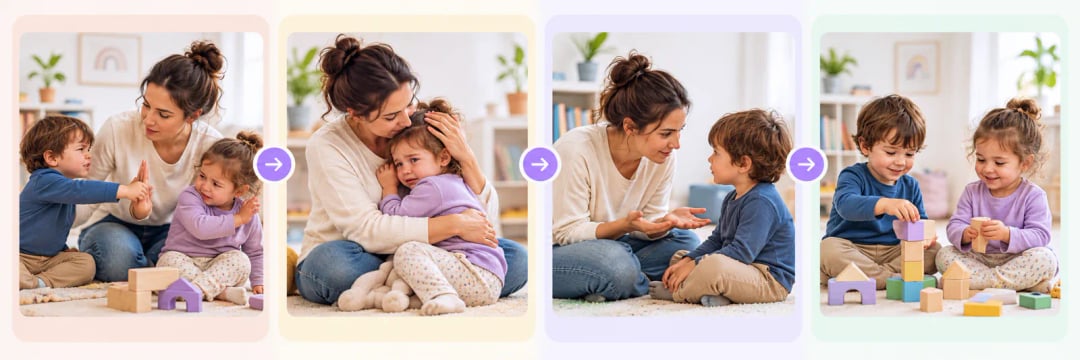
First, stop the action: gently hold the hand or separate the children. Then give your attention to the child who got hurt. That shows your child that hurting someone is not the way to get your attention.
Then get down to eye level and keep it short: “You’re mad because he took the truck. But biting hurts. You can say ‘Mine!’” Long lectures don’t work at this age.

The part of a toddler’s brain that puts the brakes on impulses is still developing, so when anger flares the brakes are weak. Children strengthen them by watching a calm adult and experiencing the same limit again and again. A child who is overwhelmed often needs help to calm down before they can listen.
Use time-in for emotional distress; use time-out for unsafe or aggressive behavior.
MedlinePlus suggests that if you use time-outs, they last about 1 minute per year of age, so a 3-year-old sits for 3 minutes.
How can I prevent biting and hitting?
Biting often happens at the same times and in the same situations. Jotting down when it happens for a few days usually reveals the trigger.
Preventing biting and hitting: 5 steps
-
Find the trigger
Tiredness, hunger, crowds and transitions are the most common; a snack and some quiet time after daycare help.
-
Give feelings words
Use words like “mad,” “sad” and “jealous” every day; play with picture cards or stuffed animals.
-
Teach what to do instead
“When you’re mad, you can stomp your feet” or “You can squeeze a pillow”; offer a teether for the urge to bite.
-
Catch the good
When your child waits a turn, say it right away: “You wanted the truck and you waited. That was great.”
-
Stay close at risky moments
During group play and toy sharing, stay a few steps away so you can step in.
The CDC also advises checking for unmet physical needs like hunger, tiredness or discomfort before anything else. A lot of biting happens right before naptime or dinner.
What if my child bites at daycare or the playground?
A call from daycare can feel mortifying. Biting is common in toddler classrooms; what matters most is that home and daycare respond the same way.
| When your child bites | When your child is bitten |
|---|---|
| Agree with the teacher on the same short sentence and response | Wash the bite with soap and water and stay calm |
| Don’t punish again at home hours later | See your pediatrician if the skin is broken or the bite is on the face |
| Track with the teacher when and where it happens | Tell your child, “That hurt. We’ll keep you safe.” |
| Be understanding about the other family’s worry | Ask daycare about their plan for the child who bit |

When daycare calls, it’s natural to wonder, “What did I do wrong?” A child who bites is not a badly raised child; they are a child learning to express themselves. When you calm your own anger first, you give them the best example there is.
What should I avoid?
The first instinct is often “Maybe if I bite back, he’ll get it.” But children copy adults, and a reaction that hurts teaches that hurting is okay when you’re angry.
| Don’t | Instead |
|---|---|
| Bite or hit back | Hold the hand gently and say, “I won’t let you bite.” |
| Yell or lecture | One short, calm sentence: “Biting hurts.” |
| Label: “Bad boy!” | Separate child from behavior: “You’re a good kid. Biting is not okay.” |
| Rush all your attention to the biter | Comfort the child who got hurt first |
| Punish hours later at home | Respond in the moment, then let it go |
For more on toddler behavior, see our behavior section, and for age-specific ideas visit the 1-3 years and 3-6 years pages.
When to see a doctor
Occasional biting and hitting between ages 1 and 3 is normal and usually eases as language develops. This table helps you tell what’s typical from what needs a closer look.
| See a doctor if | Normal |
|---|---|
| Frequent biting or hitting after age 5 | Biting now and then, in certain situations, between 1 and 3 |
| Aggression many times a day, in every setting, for no clear reason | Hitting when angry, then calming down quickly |
| Hitting themselves or banging their head | Biting everything while teething |
| Coming with a clear speech delay or trouble with eye contact | Slowly responding to your limits |
If you notice these signs, talk to your pediatrician or family doctor, who can refer you to a child development or mental health specialist if needed. Your child’s teacher or daycare director can also help you build a shared plan.
The CDC advises using time-in for emotional distress and time-out for unsafe or aggressive behavior, and checking first whether a child is hungry, tired or uncomfortable. MedlinePlus recommends keeping time-outs to about 1 minute per year of age.
General Information: This content offers general information based on expert sources. Every child, family and situation is different, so what is described here may vary from person to person. Talk to your doctor or a qualified specialist before making decisions about your child.
Was this article helpful?
Tools for this Age
- Baby percentile calculatorWhere does your child's weight and height sit among children the same age? See it in seconds on the WHO growth curves.
- Baby and child sleep scheduleHow much should your child sleep in 24 hours, and when should bedtime be? Calculate it from official guidance and compare it with your own log.
- Potty training chartWhen to start and how to prepare? A roadmap by age, a daily routine and a printable reward chart.
- Baby milestones by monthCheck off what most children your child's age can do, and talk about the rest with your doctor.
- Baby vaccine schedulePick your country, enter the birth date, and see the official schedule as your own dates.
- Baby teething chart: order and timelineEnter the date of birth to see the typical eruption window of all 20 baby teeth, the next tooth and the teeth already through — on one screen.
Checklist
Popular Topics
Frequently Asked Questions
- 1
- 2
- 3
- 4
- 5
Editorial Note
This article is general information; every child and family is different. If biting or hitting is very frequent, continues after age 5 or worries you, talk with your pediatrician or family doctor.