
 lumiya.com.tr

Calm nights, gentle mornings
Night terrors in toddlers and kids (ages 1-8): screaming but not awake
Your child sits up screaming with wide-open eyes, doesn't seem to know you, and remembers nothing in the morning? Here's how to tell a night terror from a nightmare or a seizure, what to do in those minutes, and when to call the doctor.
General Information: General information only; it may vary from child to child. Talk to your doctor or a specialist before making decisions.
In short
- A night terror is a partial wake-up from deep sleep: your child screams with eyes open but is still asleep and won't remember it in the morning.
- They're most common between ages 3 and 8, 1 to 3 hours after falling asleep; sweating and fast breathing are a normal part of those minutes.
- Don't wake your child during an episode; keep the lights low, make the space safe, and wait for it to pass on its own.
- Close the sleep gap first; when episodes come at the same time every night, a brief wake-up 15 minutes earlier is worth a try.
Lumiya Editorial TeamBased on 6 sourcesOur editorial standards
It's just after 10 p.m.: your child is sitting bolt upright in bed, eyes wide open, screaming, and when you rush in, they don't seem to know who you are. This is most likely a night terror: a partial wake-up from deep sleep.
It looks frightening, but for most children it's harmless. The short version: don't wake them, stay calm, keep them safe, and wait for it to pass; most episodes last from a few minutes up to 20 minutes.
Night terror, nightmare, or seizure?
Three possibilities run through a parent's mind, and the easiest clue is the clock: night terrors come in the first hours of the night, nightmares toward morning.
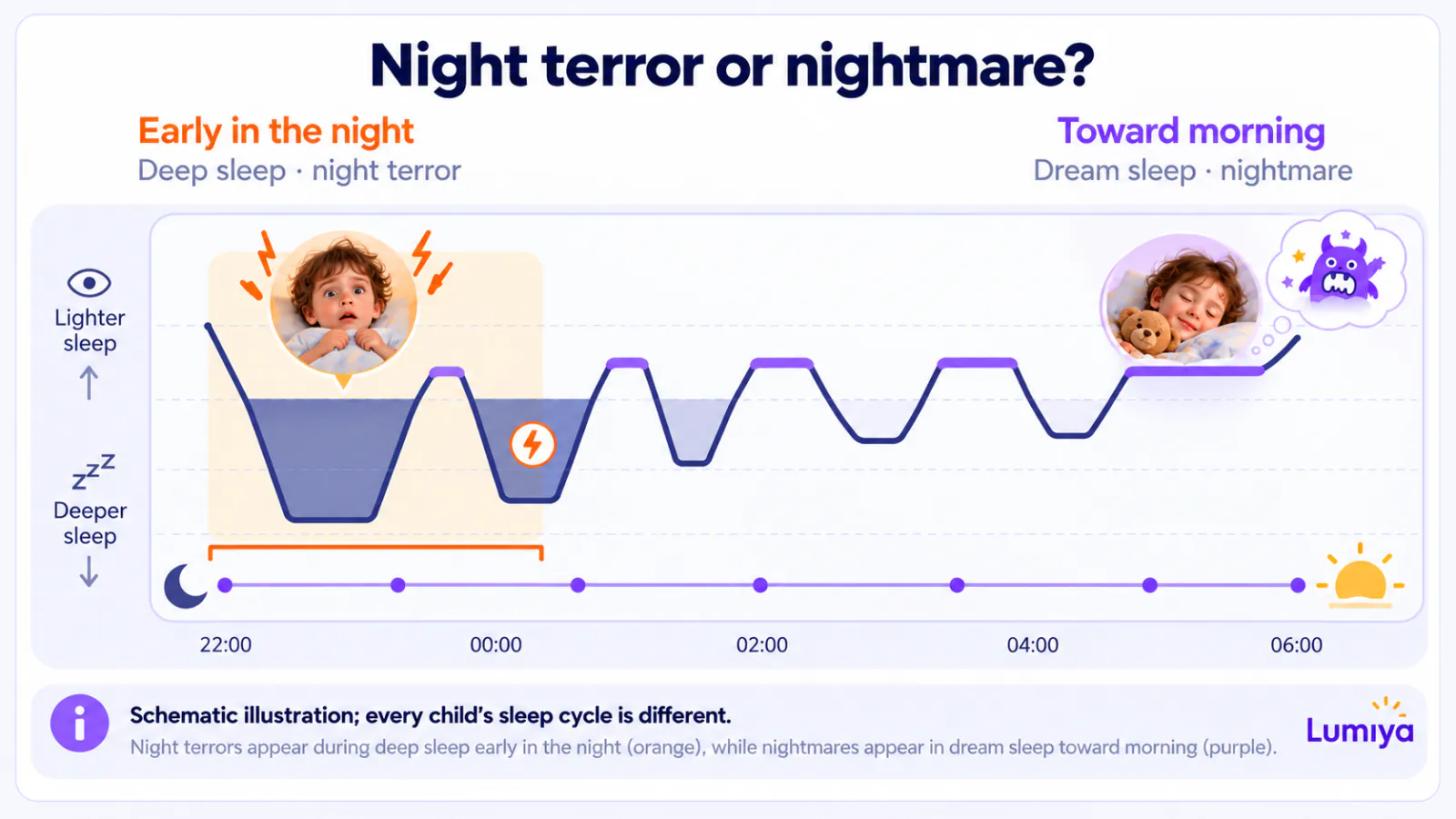
The American Academy of Pediatrics explains why they come so early:
They take place during the deepest stages of sleep.
How it differs from a nightmare, in six points:
| Sign | Night terror | Nightmare |
|---|---|---|
| When? | 1 to 3 hours after falling asleep | Second half of the night, toward morning |
| Is your child awake? | Eyes open, but still asleep | Fully awake |
| Do they know you? | Often not; may push you away | Yes, they reach for you |
| What do you notice in their body? | Sweating, fast breathing, racing heart | Fear and crying; the body calms down |
| Does comforting help? | Not really; you wait it out | Yes, they settle quickly |
| Remembered in the morning? | No | Usually they can tell you the dream |
The sweating, very fast breathing and racing heart in the table are normal during a night terror, according to MedlinePlus. They're scary to watch, but on their own they are not an emergency.
The fear of a seizure is just as common. A night terror usually happens once a night, in the early hours, and stops by itself.
Some forms of epilepsy also show up during sleep, so doctors sometimes need to tell the two apart; with epilepsy, arm and leg movements stand out more than the screaming. The table in the last section shows when to see your doctor.
A child who climbs out of bed, talks to you and knows who you are is truly awake; that's a different situation, covered in our guide to night wakings at ages 6-9. Soothing a child after a nightmare is covered in our articles on nightmares and sleep problems.
What to do during a night terror
In those minutes your goal isn't to wake your child but to get through the episode safely.
5 steps during a night terror
-
Calm yourself first
Your child isn't in pain; they're asleep. Your panic can half-wake them and make them more frightened.
-
Don't try to wake them
No shaking, no splashing water, no “Wake up, look at me!” According to the UK's National Health Service (NHS), a child you try to wake may not recognize you and may get more upset the more you try to comfort them.
-
Keep the space safe
Make sure they can't fall out of bed or head for the stairs or a window, and move hard or sharp objects out of reach. When they thrash, give them a little room instead of holding them tight.
-
Lights low, one adult quietly beside them
Don't flip on every light or crowd the room. Don't try to talk to them or hug them; just stay quietly nearby. The NHS also advises not talking to a child during these minutes.
-
Tuck them back in, skip the morning questions
Most children drift back to sleep within minutes as if nothing happened. Don't ask “Why were you screaming last night?” over breakfast; a child who doesn't remember doesn't need to hear about it.
The American Academy of Pediatrics suggests telling babysitters what night terrors are and what to do; before a sleepover at Grandma's, walk the grandparents through these steps too. One sentence is enough: “If she screams, don't wake her, keep the light low and stay close.” That way nobody panics and tries to wake your child.
Why do night terrors happen, and when do they stop?
The exact cause isn't known, but the triggers are.
MedlinePlus, from the US National Library of Medicine, lists fever, lack of sleep and periods of stress or conflict; night terrors can also run in families. For a 4-year-old, a big birthday party or a week with a fever can bring on more of these nights.
A night terror isn't a “bad dream”: it doesn't mean your child saw something awful or is afraid of something.
How night terrors change with age
-
Can begin
The American Academy of Pediatrics says night terrors occur most often in toddlers and preschoolers.
-
Most common
The NHS says night terrors are most common at these ages.
-
Fewer and farther between
MedlinePlus says episodes usually decrease after age 10.
You'll find the other sleep changes of the preschool years, when night terrors are most common, in our ages 3-6 guide.
Before you see the doctor: how to keep a sleep log
Keep a simple sleep log for 1 to 2 weeks; the NHS also recommends a sleep diary that records how long your child sleeps, to help pinpoint causes.
The log does two jobs: it gathers what your doctor will want to know, and it shows what time the night terrors start, which you'll need for scheduled awakening in the next section.
| Day | Sleep: bedtime → wake-up, nap | Night terror: time, length, how many times | What did your child do? | What happened that day? |
|---|---|---|---|---|
| Monday | 8:30 p.m. → 7:00 a.m., no nap | 10:00 p.m. · 8 min · 1 time | Sat up screaming “Go away, go away!”, didn't know me | Worn out after the park |
| Tuesday | 8:15 p.m. → 7:00 a.m., 1-hour nap | none | — | A quiet day |
| Wednesday | 9:30 p.m. → 7:30 a.m., no nap | 10:40 p.m. · 12 min · 1 time | Cried, was sweaty, lay back down | Fever of 101.3 °F |
The “What did your child do?” column is what your doctor will ask about most: was it mostly screaming or mostly arm and leg movements, did your child recognize you?
Try to catch one night on a short phone video, too; it shows the doctor far more than a description can and helps tell a night terror apart from other nighttime events.
Can you prevent night terrors? More sleep first, then scheduled awakening
The most powerful step is enough regular sleep, because an overtired brain drops into deep sleep faster and harder. These are the daily sleep totals recommended by the Centers for Disease Control and Prevention (CDC).
| Age | Total sleep per day | Note |
|---|---|---|
| 1-2 years | 11-14 hours | Including naps |
| 3-5 years | 10-13 hours | Including naps |
| 6-12 years | 9-12 hours | Mostly at night |
A 5-year-old who goes to bed at 8:30 on school nights but stays up until 11 on Saturday may well have a night terror that night. When the episodes come at the same time every night, the NHS suggests one more step: gently wake your child 15 minutes before the usual time and repeat it every night for 2 weeks.
This doesn't contradict the rule against waking them during an episode: the brief wake-up happens before a night terror starts, while your child is sleeping quietly.
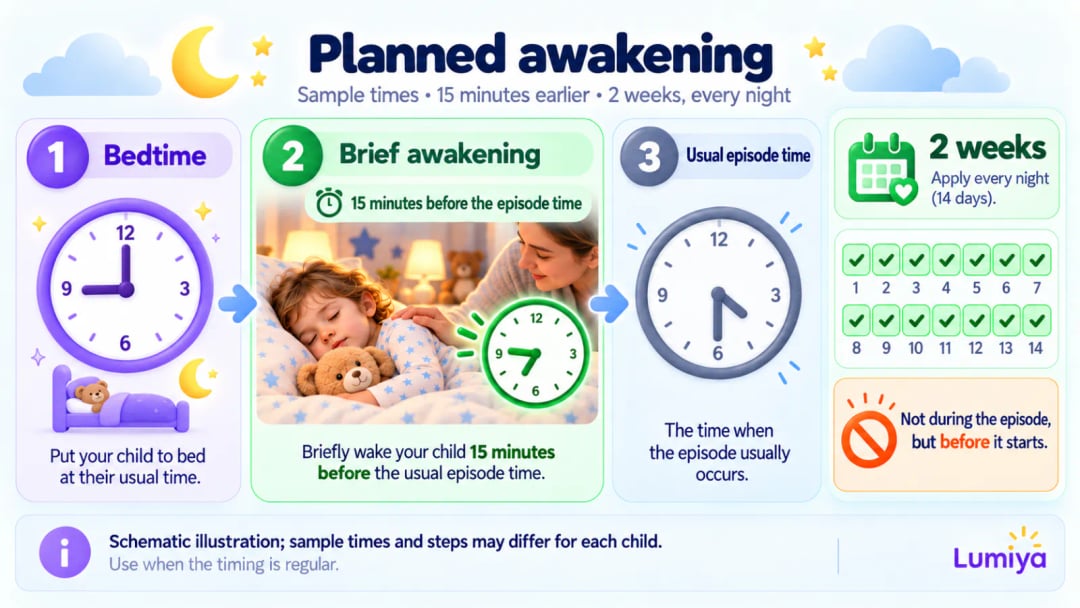
Prevention plan: sleep first, then scheduled awakening
-
Check total sleep against the table
From the sleep column of your log, work out the average total sleep over a week (night plus naps); if it falls below the range in the table above, fix that first.
-
Move bedtime earlier and keep it on weekends
Shift bedtime earlier a little at a time and hold it on Saturday and Sunday too. Hang on to the nap as long as your child still needs it.
-
Turn off screens before bed
The CDC recommends turning off electronic devices at least 30 minutes before bedtime.
-
Same time every night? Wake 15 minutes earlier
This method works only when night terrors start at about the same time every night: if your log shows most episodes starting around 9:30 p.m., your wake-up time is 9:15 p.m. If the start time varies clearly from night to night (like 10:00 and 10:40 p.m. in the sample log), this method isn't suitable; focus on the sleep routine instead.
-
Wake gently and keep it up for 2 weeks
Touch their shoulder; it's enough for them to open their eyes and look at you or mumble something, then let them drift back to sleep. Repeat at the same time every night for 2 weeks. If night terrors haven't eased or have become more frequent after two weeks, talk to your doctor.
When should night terrors be checked by a doctor?
Night terrors that happen now and then, pass on their own and leave no trace by morning are normal at this age. See your doctor in the situations below; they may refer you to a pediatric neurologist or a sleep specialist. The criteria come from MedlinePlus and the NHS.
A note: night terrors are most common at ages 3 to 8, but in most children they start earlier. That's why the NHS recommends seeing a doctor for night terrors that start for the first time after age 5; night terrors that began earlier and continue at ages 5-8 aren't a reason to see a doctor on their own.
| Watch for this — see a doctor | Normal |
|---|---|
| Happens often, or regularly disrupts sleep (either one is enough) | Happens now and then; your child and the rest of the family are rested during the day |
| Started for the first time after age 5, or continues past age 12 | Started before age 5, getting less frequent with age |
| A pattern over many nights: happens several times a night on most nights, or arm and leg movements regularly stand out more than the screaming | In the early part of the night, once a night |
| Other symptoms too: e.g., snoring every night with repeated short pauses in breathing during sleep, or heavy daytime sleepiness | No change in their daytime play, appetite or mood |
| Got hurt, or nearly did (fell out of bed, headed for the stairs) | Sits up and screams, then goes back to sleep |
This table is for patterns over many nights; if you see stiffening or jerking for the first time that night, go by the ambulance criteria below.
Fast breathing and thrashing are common in a night terror. In a seizure, the NHS describes the body or part of it going stiff, twitching or shaking, and the eyes may roll to one side, while the head can turn.
If you see that, the NHS first-aid guide says to call an ambulance if: it's the child's first seizure, it lasts more than 5 minutes, the child doesn't fully come around afterward or has one seizure after another without coming around in between, is seriously injured, or has trouble breathing after the seizure.
In the US, the emergency number is 911.
The UK's National Health Service (NHS) says most children outgrow night terrors on their own and that treatment depends on the cause: if a condition that disrupts sleep, such as sleep apnea, is present, managing that condition is the main treatment. That's why the snoring and breathing-pauses row in the table matters.
General Information: This content offers general information based on expert sources. Every child, family and situation is different, so what is described here may vary from person to person. Talk to your doctor or a qualified specialist before making decisions about your child.
Was this article helpful?
Tools for this Age
- Baby percentile calculatorWhere does your child's weight and height sit among children the same age? See it in seconds on the WHO growth curves.
- Baby and child sleep scheduleHow much should your child sleep in 24 hours, and when should bedtime be? Calculate it from official guidance and compare it with your own log.
- Potty training chartWhen to start and how to prepare? A roadmap by age, a daily routine and a printable reward chart.
- Baby milestones by monthCheck off what most children your child's age can do, and talk about the rest with your doctor.
- Baby vaccine schedulePick your country, enter the birth date, and see the official schedule as your own dates.
- Baby teething chart: order and timelineEnter the date of birth to see the typical eruption window of all 20 baby teeth, the next tooth and the teeth already through — on one screen.
Checklist
Popular Topics
Frequently Asked Questions
- 1
- 2
- 3
- 4
- 5
References & Further Reading
- 1
- 2
- 3
- 4
- 5
- 6
Editorial Note
This article is general information; every child's sleep is different and it does not replace an exam. Talk to your doctor about your child.