
 lumiya.com.tr
Healthy children, brighter tomorrows
Fever in a Baby Under 3 Months: When to Go to the ER
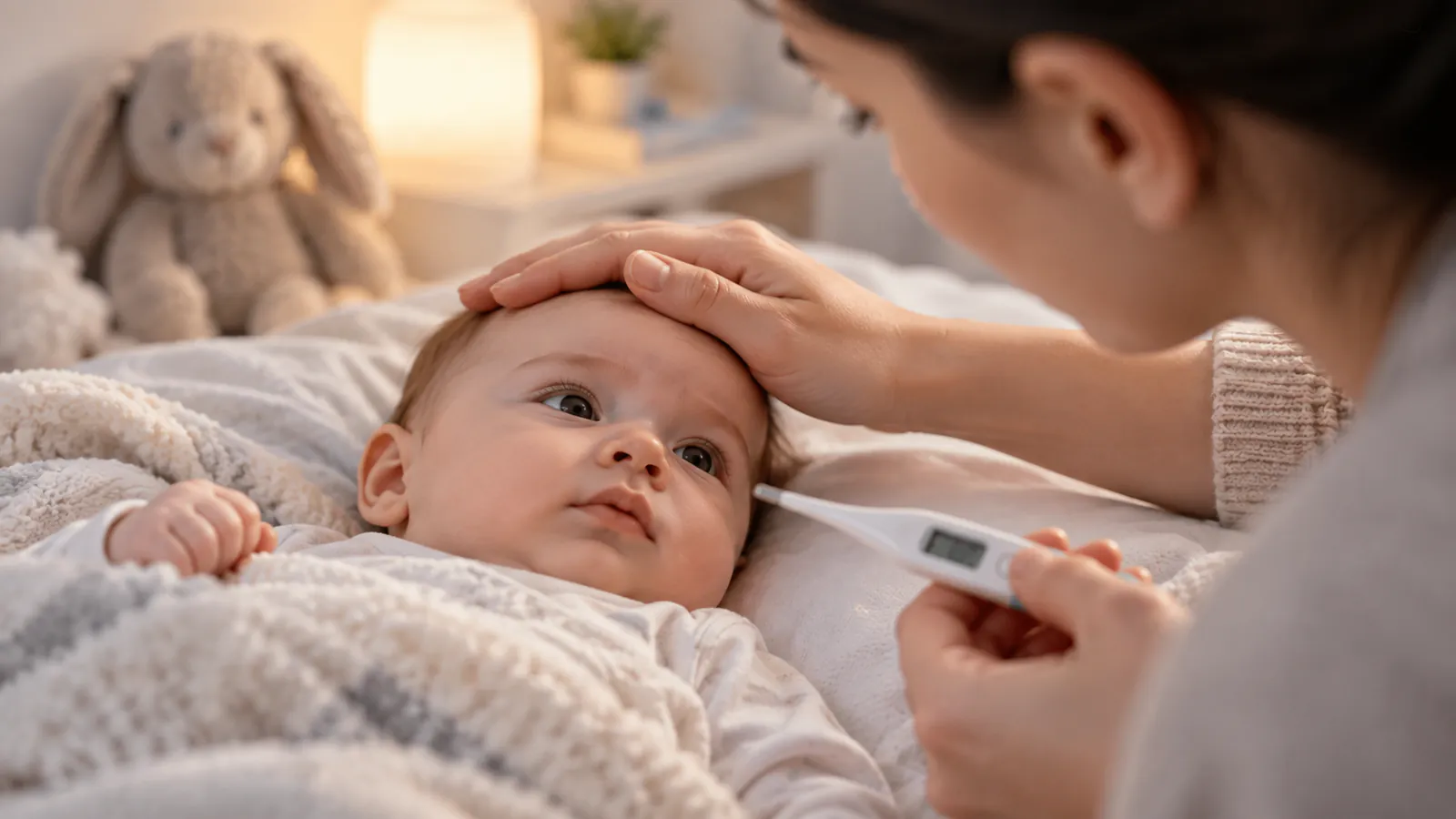
A temperature of 100.4 °F (38 °C) or higher in a baby younger than 3 months needs a doctor right away, even if your baby seems fine. Here is what to do.
General Information: General information only; it may vary from child to child. Talk to your doctor or a specialist before making decisions.
In short
- In a baby younger than 3 months, a temperature of 100.4 °F (38 °C) or higher needs a doctor right away.
- At this age, fever can be the first and only sign of a serious but treatable infection.
- Do not give fever medicine unless a doctor tells you to, and do not bundle or cold-bathe the baby.
- Call 911 for trouble breathing, bluish skin, a baby who is hard to wake or who refuses to feed.
Lumiya Editorial TeamBased on 3 sourcesOur editorial standards
Our tool for this topic
If your baby is younger than 3 months and has a temperature of 100.4 °F (38 °C) or higher, call your pediatrician right away, even if your baby seems fine. If you cannot reach them, go to the nearest emergency room. Call 911 if your baby is struggling to breathe, looks bluish or is hard to wake.
Why fever matters more in the first 3 months
In older children, fever is usually part of a common cold and can be watched at home. The first three months are different. A young baby cannot tell you what hurts, symptoms can be very subtle, and a serious but treatable infection may show up only as a fever. That is why the American Academy of Pediatrics advises that any fever at this age be checked by a doctor, not watched at home.
At the visit, the doctor will look at how your baby is feeding, how many wet diapers there have been and how alert your baby is. Urine or blood tests are common at this age; they are a way to find the cause early, not a sign that something is wrong. We cover how fever is handled in older children separately, but the rule for babies under 3 months is stricter.

A newborn's immune system is still developing, and the antibodies passed on from the mother do not protect against every germ. That is why an infection that needs early treatment, such as a urinary tract infection, can appear with fever as its only sign. Fever itself is usually the body's defense response; what matters is finding its cause in time.
The first 4 weeks: an even stricter rule
If your baby is younger than 28 days, do not wait on hold with a nurse line when you find a fever: go straight to the nearest emergency room. A newborn's defenses are at their weakest, and doctors usually want to evaluate newborns in the hospital.
What counts as a fever, and how do you measure it?
Taking a baby's temperature correctly starts with a digital thermometer; glass mercury thermometers can break and are no longer recommended. The American Academy of Pediatrics considers a rectal reading the most reliable for babies, especially those under 3 months, and your pediatrician can show you how to do it safely with a little petroleum jelly.
| Where you measure | Reliability at this age | When to act |
|---|---|---|
| Rectal | Most reliable | 100.4 °F (38 °C) or higher: call now |
| Armpit | Can read low | 99.5 °F (37.5 °C) or higher: confirm rectally or call |
| Ear | Not used under 3 months | Do not use at this age |
| Forehead / no-touch | First check only | If in doubt, measure rectally |
| Any method | Low is serious too | Below 97 °F (36 °C): call |
Do not take the temperature right after a bath or while your baby is bundled in blankets. Write down the number, the time and how you measured it; the nurse or doctor will ask for all three.
What to do right now
First steps when you find a fever
-
Write it down
Note the temperature, the time and how you measured it.
-
Call your pediatrician
Call the office or the after-hours line now; if you cannot reach anyone, go to the ER.
-
Skip medicine for now
Do not give fever medicine to a baby under 3 months unless a doctor tells you to.
-
Keep feeding
Keep breastfeeding or offering formula and track wet diapers.
-
Dress lightly
Remove extra blankets; light clothing at room temperature is enough.
Bring your baby's feeding and diaper notes to the visit. Always travel with your baby buckled in the car seat, never on your lap.
What happens at the hospital?
The doctor examines your baby from head to toe and asks about feeds and wet diapers. For babies under 3 months, urine and blood tests are common, and sometimes the spinal fluid is checked too. Newborns in particular may stay for observation until results come back, and treatment may start early. These steps are routine at this age: the goal is not to miss a treatable infection.
Home do's and don'ts
| Situation | Don't | Do instead |
|---|---|---|
| The fever rises | Cold baths or rubbing alcohol | Light clothing and a call to your pediatrician |
| The baby is fussy | Heavy bundling to sweat it out | Light layers at room temperature |
| The fever drops on its own | Skipping the doctor | Getting the baby checked anyway |
| There is medicine at home | Using an older sibling's medicine | Asking your pediatrician or pharmacist |
A few common beliefs about fever can delay care for a young baby:
| Myth | Fact |
|---|---|
| Teething causes a high fever. | Teething does not cause a high fever; do not blame a fever on teeth at this age. |
| Sweating it out brings the fever down. | Bundling raises body temperature; dress your baby lightly. |
| Fever damages a baby's brain. | Fever itself rarely causes harm; finding its cause is what matters. |
| Aspirin is a safe fever reducer. | Aspirin is not given to children because of its link to Reye's syndrome. |
| A fever after vaccines is always expected. | Under 3 months, call your pediatrician about a fever after vaccines too. |
Lowering the risk of infection
Simple habits protect a young baby best. Wash your hands before touching the baby, ask sick visitors to wait, and do not let anyone kiss your baby's face. Breast milk supports the immune system. Keeping up with the CDC immunization schedule recommended by your pediatrician is the strongest protection against serious infections. You can find more of our health and safety guides here.
When to see a doctor
In a baby younger than 3 months, a temperature of 100.4 °F (38 °C) or higher is on its own a reason to call the doctor, even with no other symptoms. Any of these warning signs means an emergency: call 911 or go to the nearest ER right away.
- Trouble breathing, grunting, or the skin pulling in between the ribs with each breath
- Blue or gray lips or skin, or very pale, blotchy skin
- A baby who is hard to wake, floppy or not responding
- Constant, high-pitched or very weak crying
- Refusing to feed, repeated vomiting or far fewer wet diapers
- A bulging soft spot, a rash that does not fade when pressed, or a seizure
- A temperature below 97 °F (36 °C)
MedlinePlus, from the U.S. National Library of Medicine, lists fever in young infants among the situations that need prompt medical care. This article is general information; every baby is different, and the decision always belongs to the doctor who examines your baby. For everyday care at this stage, see our 0-12 months guide.

It is completely normal to panic when you see a high number on the thermometer in the middle of the night. At this age there is no such thing as being too careful: calling the doctor or heading to the ER is the right call. The short note you bring along, with the reading, the time, feeds and diapers, helps the care team and helps you stay calm.
Health Information: The content and guidance in this article are prepared solely to inform parents, based on current medical literature and scientific research. The information provided here does not, in any way, replace direct medical diagnosis, treatment, or professional medical advice. If you have any concerns or doubts about your baby's health or development, please consult a pediatrician or your healthcare provider without delay.
Was this article helpful?
This topic at other agesHealth & Safety
Tools for this Age
- What temperature is a fever in children?See whether the temperature you measured counts as a fever according to your country's official health source, when to get help at your child's age and the warning signs.
- Baby percentile calculatorWhere does your child's weight and height sit among children the same age? See it in seconds on the WHO growth curves.
- Baby and child sleep scheduleHow much should your child sleep in 24 hours, and when should bedtime be? Calculate it from official guidance and compare it with your own log.
- Baby milestones by monthCheck off what most children your child's age can do, and talk about the rest with your doctor.
- Baby vaccine schedulePick your country, enter the birth date, and see the official schedule as your own dates.
- Baby teething chart: order and timelineEnter the date of birth to see the typical eruption window of all 20 baby teeth, the next tooth and the teeth already through — on one screen.
Popular Topics
Frequently Asked Questions
- 1
- 2
- 3
- 4
Editorial Note
This article is general information, and every baby is different. If your baby is younger than 3 months and has a fever, call your pediatrician now or go to the nearest emergency room.