 lumiya.com.tr
Learning begins with curiosity
Child refuses to go to school: a practical plan for ages 5–12
Respond to repeated school refusal with a calm morning conversation, attention to physical complaints, and a concrete support agreement with school.
General Information: General information only; it may vary from child to child. Talk to your doctor or a specialist before making decisions.
In short
- Repeated school refusal describes a difficulty, not a diagnosis made at home.
- Take physical symptoms and reports of threats seriously before planning attendance.
- Agree with school who will meet the child and how support and updates will work.
- Seek professional help when refusal keeps disrupting attendance or daily life.
Lumiya Editorial TeamBased on 3 sourcesOur editorial standards
A child who repeatedly refuses school needs more than another argument at the front door.
Start by checking whether they are ill or unsafe, listen for the part of school that feels difficult, and contact the school to arrange support. For children ages 5–12, a clear plan between home and school is more useful than shame, physical force, or an open-ended absence.
When getting out the door keeps breaking down
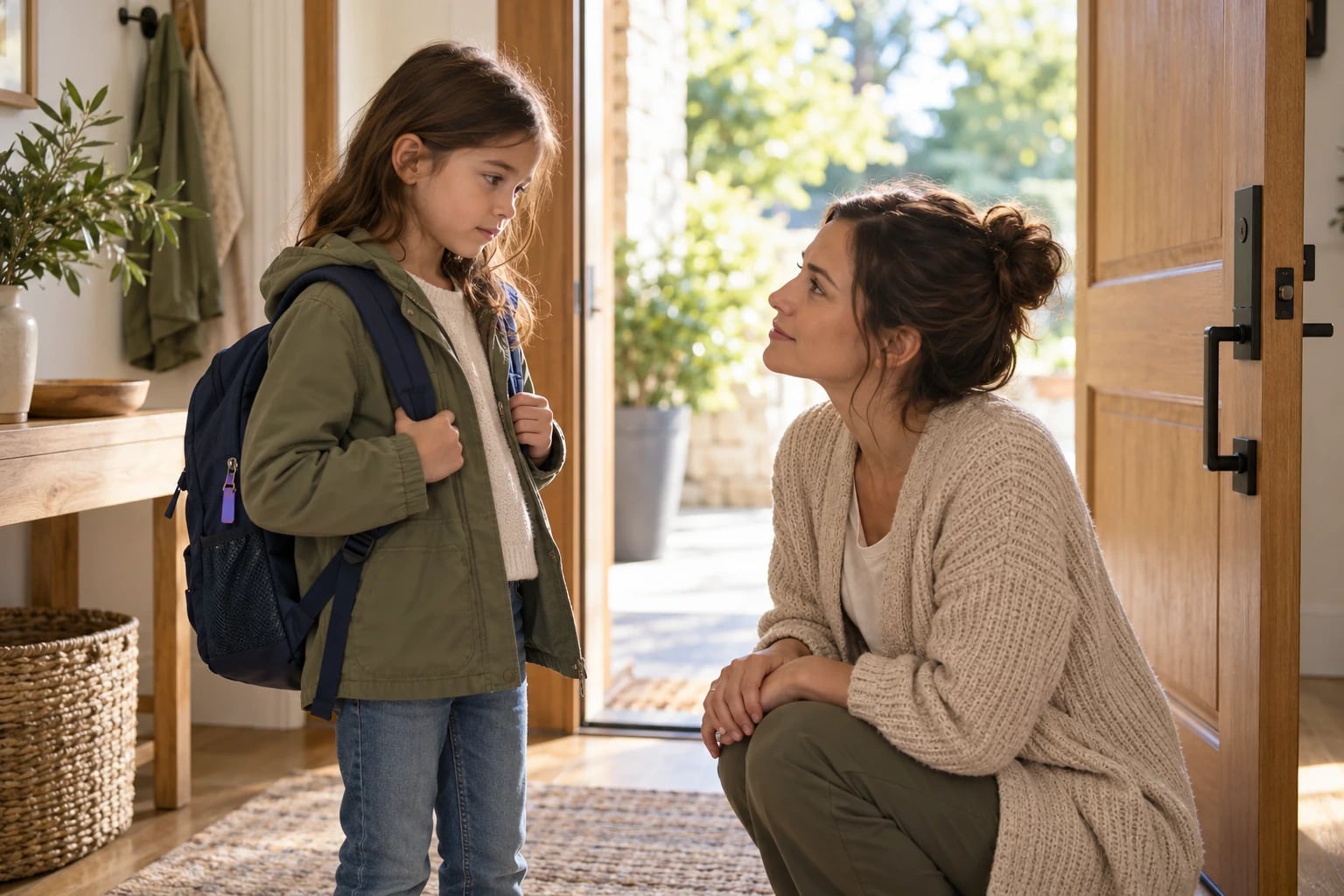
The backpack is ready, but your child cannot move past the doorway. Perhaps yesterday went reasonably well; perhaps a stomachache appears whenever it is time to leave. School refusal describes a pattern of difficulty attending, rather than a diagnosis you can make from that morning alone.
Physical discomfort deserves attention. A headache or stomachache that improves away from school can still be real, and that pattern does not rule out physical illness. New, severe, or worsening pain, fever, or other clear signs of illness call for medical assessment rather than an assumption that the problem is anxiety.
The American Academy of Pediatrics' parent guidance recommends a medical evaluation when school avoidance involves physical complaints. It also describes different possible pressures, including schoolwork, peer relationships, and using the school bathroom. A question such as “Which part of the day feels hardest?” leaves more room for an answer than “Why are you doing this again?”
A quieter response to a difficult morning
Keep the immediate conversation brief enough for a distressed child to follow. “I believe that this feels hard, and we will work on it together” acknowledges the experience without promising an instant solution. Adults can discuss disagreements about the plan privately, rather than asking the child to choose between them.
Make the next conversation manageable
-
Check illness and safety first
Take physical complaints and reports of threats seriously before deciding on the next school step.
-
Find one difficult moment
Ask about arrival, a class, or recess instead of trying to solve the entire school day at once.
-
Arrange a named support person
Contact the school to agree who will meet your child and where help will be available.
A small choice might be, “Shall we ask your teacher about meeting at the entrance, or about checking in with the counselor?” Choices sit within an agreed plan, when attending is medically appropriate and the setting is safe. Dragging a child through the door, threatening punishment, or disappearing without an agreed goodbye does not create that support.
Listen for the obstacle, not a confession
Later, away from the rush, ask about an ordinary school moment: “Where do you go when you need help?” or “What happens at recess when you cannot find someone to play with?” Leave room for an answer that is incomplete. A child may need another conversation before they can describe what is happening.

Consider academic pressure, a difficult transition, bathroom worries, separation, exclusion, and bullying without deciding in advance which explanation fits.
A report of a threat needs a safeguarding response, rather than reassurance that everything will be fine. Contact the school's responsible staff and establish how safety will be protected; do not send a child into a known danger while ignoring that report.
This is different from preparing for the first school day. A child who previously attended but now repeatedly struggles needs the current obstacle investigated, even when the family already has a reliable morning routine.
Turn a school conversation into an arrival agreement
Contact the teacher the same day and describe what you actually observed. For example: “She stops at the entrance and says recess feels lonely. Who could meet her, and how can we find out what happens after drop-off?” Include the school counselor or nurse when relevant.
The American Academy of Pediatrics describes school staff, families, students, and pediatricians working together to help children stay in or return to school. School observations can inform the assessment and the support a child receives.
Concern is a reason to assess, not to guess a diagnosis
There is a difference between healthy anxiety and anxiety disorders.
Agree on a named adult, a meeting point, a place to request help, and how the family will receive an update. A gradual return may be appropriate for some children, but its steps belong in an individual plan with school staff and a qualified health professional. A fixed schedule promising full attendance after a few days would overlook important differences.

| Avoid | Try instead | What it changes |
|---|---|---|
| “Everyone else manages. Stop making a fuss.” | “Tell me which part feels difficult today.” | Replaces comparison with useful information. |
| “Go in or you will be punished.” | “We are arranging who can help when you arrive.” | Makes adult support explicit. |
| “Stay home until you feel ready.” | “We will contact school today and agree on the next step.” | Replaces indefinite waiting with a supported plan. |
Adjust the plan to your child, then review the day
For a child around 5–7, a short description of who will be at the door may be easier to use than a discussion of the whole week. A 6-year-old might explain a problem by describing a single moment. With children around 8–12, ask directly about friendship groups, classroom presentations, workload, and privacy; these age groupings are examples, not developmental cutoffs.
An 11-year-old may want to agree which details are shared with their teacher. Use private school communication channels rather than a class group chat. The 6–9 years guide and 9–12 years guide provide broader context for changing needs.
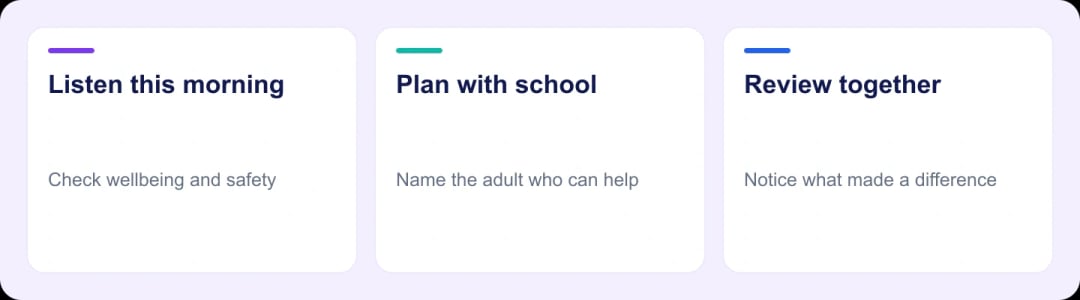
After school, notice more than the length of attendance. Asking for help, meeting the agreed adult, or explaining a difficult moment are also efforts worth recognizing. Brief notes about what happened and what helped can inform the next conversation; they are not a diagnostic scorecard.
When school refusal needs a doctor or specialist
One reluctant morning does not establish a disorder. Repeated refusal, missed learning, or substantial disruption to sleep, eating, and family life are reasons to seek help rather than extend a wait-and-see period. Contact your child's pediatrician or primary care clinician alongside the school counselor; they can advise on further child mental health support.
CDC guidance recommends discussing concerning anxiety with a healthcare professional for an evaluation. Seek prompt medical assessment for new, severe, or worsening physical complaints. An immediate threat to a child's safety calls for local emergency assistance, not a routine school meeting.
General Information: This content offers general information based on expert sources. Every child, family and situation is different, so what is described here may vary from person to person. Talk to your doctor or a qualified specialist before making decisions about your child.
Was this article helpful?
This topic at other agesSchool & Learning
Tools for this Age
- Baby percentile calculatorWhere does your child's weight and height sit among children the same age? See it in seconds on the WHO growth curves.
- Baby and child sleep scheduleHow much should your child sleep in 24 hours, and when should bedtime be? Calculate it from official guidance and compare it with your own log.
- Potty training chartWhen to start and how to prepare? A roadmap by age, a daily routine and a printable reward chart.
- Baby milestones by monthCheck off what most children your child's age can do, and talk about the rest with your doctor.
- Baby vaccine schedulePick your country, enter the birth date, and see the official schedule as your own dates.
- Screen time by ageSee how much screen time a day your country's official body recommends at your child's age; add daily use to compare it with the advice.
Checklist
Popular Topics
Frequently Asked Questions
- 1
- 2
- 3
- 4
- 5
Editorial Note
This guide offers general information about home–school cooperation. It does not replace an individual medical assessment or treatment plan.
Other situations in this topic
Dealing with a different side of the same topic? Each situation has its own guide.